
The debate between heat pump vs air conditioner comes up in almost every conversation about home climate control, and it is worth resolving properly because the two are far more closely related than most comparisons admit.
Here is the short answer. An air conditioner and a heat pump are the same machine. They use an identical refrigeration cycle, the same compressor, the same refrigerant, and the same heat exchangers. The difference is a single component, and understanding that changes how you should approach the decision.
They Are the Same Machine With One Extra Part
An air conditioner moves heat. It absorbs heat from indoor air, carries it in refrigerant to the outdoor unit, and releases it outside. That is all cooling is: not the creation of cold, but the removal of heat and its transport elsewhere.
A heat pump does exactly the same thing. The distinction is that it contains a reversing valve, which allows the refrigerant flow to be switched so the cycle runs in the opposite direction. Instead of taking heat from inside and dumping it outside, it takes heat from outside and delivers it inside.
That is the entire difference. Every air conditioner is a heat pump that only runs one way. Every heat pump is an air conditioner that can also run backwards.
Why this matters for the decision. If the two machines are fundamentally the same, then in cooling mode a good heat pump and a good air conditioner perform identically. The heat pump is not a better cooler. What it is, is a machine that also heats. The real question is therefore not which cools better, but whether you need heating as well, and what you would otherwise install to provide it.
This reframing is useful because it removes a lot of noise. Comparisons that claim a heat pump cools more efficiently than an air conditioner are usually comparing a modern inverter heat pump against an older fixed-speed air conditioner. That is a comparison of technology generations, not of categories.
Air-to-Air and Air-to-Water: The Distinction That Actually Matters
Before going further, there is a second distinction that causes more confusion than the first, and it determines which products you should even be looking at.
Air-to-air systems take heat from outdoor air and deliver it directly into indoor air. The indoor unit blows conditioned air into the room. This is what a split air conditioner does, and what a reversible split heat pump does. There is no water involved anywhere.
Air-to-water systems take heat from outdoor air and transfer it into water. That water then circulates through underfloor heating loops, radiators, or a domestic hot water cylinder. The rooms are warmed by the floor or the radiators, not by blown air.
| Aspect | Air-to-air | Air-to-water |
|---|---|---|
| Delivers heat into | Indoor air directly | Water circuit |
| Emitter | Wall or ceiling indoor unit | Underfloor loops, radiators, fan coils |
| Domestic hot water | No | Yes, with a cylinder |
| Response speed | Fast | Slower, steadier |
| Cooling | Straightforward | Possible with radiant cooling design |
| Typical market | Asia, North America, Southern Europe | Northern and Central Europe |
The practical consequence is that these are not interchangeable products. If your building has wet heating with radiators or underfloor loops, you need air-to-water. If it has ducts or nothing at all, air-to-air may suit better. Ordering the wrong category is a common and expensive error in international sourcing.
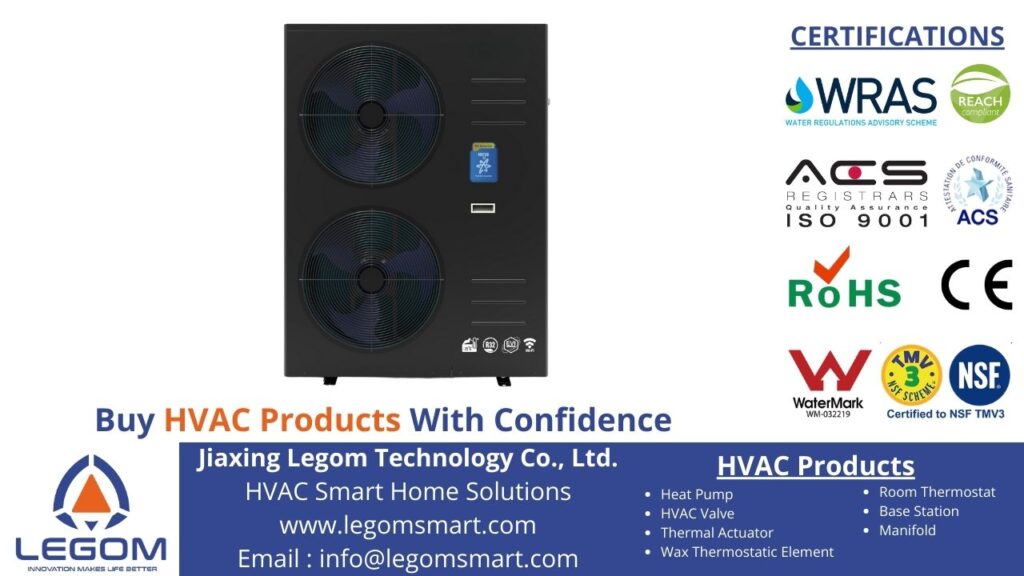
Legom manufactures air-to-water monoblock heat pumps, delivering hot or chilled water to hydronic systems. We do not produce air-to-air split air conditioners, and being clear about that saves buyers a wasted enquiry.
Heat Pump vs Air Conditioner: Key Differences
With the mechanism understood, the meaningful differences reduce to a short list.
Function
Heat pumps transfer heat in both directions, providing heating and cooling from one machine. Air conditioners remove heat from indoors and release it outdoors, and are limited to cooling only. This is the primary difference and the one that drives the decision.
Efficiency
This is where most comparisons go wrong, so it is worth setting out carefully.
In cooling mode, a heat pump and an air conditioner of comparable quality perform the same. Both are measured by EER or SEER, and there is no inherent advantage either way. A high-quality inverter unit of either type will outperform a basic fixed-speed unit of either type.
In heating mode, the comparison is not between two machines but between a heat pump and whatever else would provide the heating. Here the heat pump advantage is real and substantial. Measured by COP, a modern unit delivers three to four units of heat for every unit of electricity consumed, because it moves existing heat rather than generating it. Direct electric heating manages one unit for one unit. A gas boiler converts fuel at up to about 95%.
Understanding the metrics prevents comparing unlike figures:
| Metric | Measures | Applies to |
|---|---|---|
| COP | Heat output per unit of electricity, at one test condition | Heating |
| EER | Cooling output per unit of electricity, at one test condition | Cooling |
| SCOP | Seasonal heating efficiency across a whole season | Heating |
| SEER | Seasonal cooling efficiency across a whole season | Cooling |
The seasonal figures, SCOP and SEER, are the more useful ones when comparing products, because they account for performance across varying conditions rather than at a single laboratory point. A unit with an impressive COP at mild conditions may perform ordinarily across a real winter.
Installation cost
A heat pump generally costs more upfront than a cooling-only air conditioner of equivalent capacity, because of the reversing valve, the additional controls, and in air-to-water systems the hydraulic components. How much more depends heavily on what is already installed in the building.
Running cost
In cooling, running costs are comparable for comparable equipment. In heating, the heat pump wins decisively against direct electric heating, and usually against oil. Against gas, the outcome depends on the local ratio between electricity and gas prices rather than on the equipment, which is why the same heat pump can be cheaper to run than a boiler in one country and more expensive in another.
Lifespan and maintenance
Both use the same core components and have similar service lives, typically 10 to 15 years with proper maintenance, sometimes longer. A heat pump works year-round rather than seasonally, which means more operating hours, though modulating inverter operation offsets much of that by reducing start-stop wear.
Choosing Based on Climate
Understanding the climate of your region makes the decision considerably easier, and it is the single most useful filter.
Consistently hot climates with no real winter
If heating is genuinely never required, a cooling-only air conditioner is the sensible choice. Paying for a reversing valve and heating capability that will never be used adds cost without benefit. This applies to much of the tropics and to warm coastal regions.
Climates with both a summer and a winter
This is where a heat pump makes the strongest case, and it covers most of Europe, much of North America, and a large share of temperate Asia. One machine handles both seasons, avoiding the purchase, installation, and maintenance of separate heating equipment. For a household that would otherwise buy an air conditioner plus a boiler or electric heaters, the heat pump is frequently cheaper overall despite its higher unit price.
Cold climates
The old objection that heat pumps fail in cold weather is largely outdated for current equipment. Modern cold-climate units maintain useful output well below freezing. Legom air-source heat pumps are engineered to keep operating at ambient temperatures down to -35°C, which covers the great majority of populated cold regions including Northern and Eastern Europe.
Output does decline as temperature falls, which is unavoidable physics for any air source unit rather than a product weakness, so cold-climate projects should be sized against the local design temperature rather than the nominal rating. In the most extreme locations a supplementary heat source may still be sensible.
Types of Heat Pump
Heat pumps are categorised primarily by where they draw heat from.
Air source heat pumps extract heat from outdoor air in winter and reverse the process in summer to provide cooling. They require no excavation, which makes them the most widely installed type worldwide.
Ground source (geothermal) heat pumps use the stable temperature of the ground, extracting heat in winter and rejecting it in summer. Efficiency is higher and more consistent than air source because ground temperature varies far less than air temperature, but installation requires excavation for a horizontal loop or drilling for a borehole, and both cost considerably more.
Hybrid heat pumps pair an electric heat pump with a gas or oil boiler, switching between them according to outdoor temperature and efficiency. This suits retrofit projects where a full conversion is impractical, and allows the heat pump to be sized for typical rather than peak demand.
Mini-split heat pumps are ductless air-to-air systems with an outdoor compressor unit and one or more indoor units connected by small refrigerant lines. They install far more easily than ducted systems and give room-by-room control.
For a fuller treatment of each type and where it belongs, see our guide on types of heat pumps for various applications, and our assessment of the pros and cons of heat pumps.
Types of Air Conditioner
Air conditioners are categorised mainly by how they are installed and how far they distribute cooled air.
Window units are compact self-contained systems fitted into a window or wall opening, ideal for cooling a single room and easy to install or remove. They are the cheapest option and the noisiest, since the compressor sits in the same casing as the indoor components.
Split systems separate the compressor and condenser outdoors from the evaporator indoors, connected by refrigerant pipework. Popular in homes and small offices for their efficiency and quiet indoor operation.
Central air conditioning cools an entire building through ductwork from a single unit, controlled by a central thermostat. It delivers uniform cooling with no visible indoor units, at the cost of complex duct installation. Our article on the pros and cons of central air conditioning covers this in detail.
Portable units are free-standing and movable, venting through a window with an exhaust hose. Convenient for temporary cooling but the least efficient, partly because the exhaust hose radiates heat back into the room it is cooling.
For installation requirements across all these types, see our guide to air conditioner installation.
The Decision Framework
Working through five questions in order settles most cases.
1. Do you need heating at all?
If genuinely not, buy a cooling-only air conditioner. Everything else follows from this answer, and it eliminates the comparison entirely for a large share of buyers.
2. If you need heating, what would the alternative be?
The heat pump’s value is measured against whatever else would provide heating. Against direct electric heaters the advantage is enormous. Against an existing serviceable gas boiler it is more finely balanced and depends on local fuel prices.
3. What does the building already have?
Existing ductwork favours air-to-air or central systems. Existing wet pipework with radiators favours air-to-water. Neither present means the choice is genuinely open, and in a new build the combination of air-to-water with underfloor heating is increasingly standard.
4. What temperature do your emitters need?
This question is skipped far too often and it determines whether an air-to-water heat pump performs well or disappointingly. Underfloor heating operates at 30 to 45°C, where a heat pump is at its most efficient. Radiators sized for a gas boiler expect 70 to 80°C, which forces the heat pump into its least efficient range.
The effect is not marginal. A unit producing 35°C water might achieve a COP around 4.5; the same unit producing 45°C might achieve around 3.6. That is roughly 25% more heat from the same electricity, from an identical machine, determined entirely by what it is feeding.
5. What is your horizon?
Equipment lasts 10 to 15 years or more, so the purchase price is a fraction of total cost. A household planning to stay should weight running cost heavily. One planning to move within a few years may reasonably weight upfront cost more.
Head-to-Head Summary
| Factor | Heat pump | Air conditioner |
|---|---|---|
| Core mechanism | Refrigeration cycle | Refrigeration cycle, identical |
| Key difference | Has a reversing valve | No reversing valve |
| Function | Heating and cooling | Cooling only |
| Cooling efficiency | Same as comparable AC | Same as comparable heat pump |
| Heating efficiency | COP 3–4, far above electric heating | Not applicable |
| Domestic hot water | Yes with air-to-water plus cylinder | No |
| Upfront cost | Higher | Lower |
| Separate heating equipment needed | No | Yes, where heating is required |
| Best suited to | Climates with a real winter | Consistently hot climates |
Underfloor Heating as Part of the Equation
In addition to air conditioners and heat pumps, it is worth considering an underfloor heating system as part of your home’s climate control solution. Underfloor heating provides radiant warmth from the ground up, offering even heat distribution, and it integrates with heat pump systems to maximise energy efficiency and maintain a comfortable indoor environment year-round.
The pairing works because of the flow temperature relationship described earlier. Underfloor heating asks for exactly the low water temperatures at which a heat pump is most efficient, so the two technologies reinforce each other rather than compromising. This is why they are so consistently specified together in new construction across Europe.
A complete hydronic installation needs more than the heat source. Warm water reaches a manifold that distributes it between individual floor heating pipe loops, each controlled by a thermal actuator responding to its own room thermostat. Specifying these alongside the heat pump rather than afterwards is what turns a correctly sized system into one that performs as intended.
“The question I get asked is which is better, and the honest answer is that it is close to the wrong question. They are the same machine with one extra valve. What people are really asking is whether they should buy something that heats as well as cools, and that depends entirely on whether they have a winter. If you do not, buy the air conditioner and spend the saving elsewhere. If you do, the interesting comparison is not heat pump against air conditioner, it is heat pump against the boiler or the electric heaters you would otherwise be running alongside the air conditioner. Framed that way the arithmetic usually becomes obvious very quickly.”
— Maggie Shen, Director of Legom
Conclusion
Choosing between a heat pump and an air conditioner depends on your climate, your building, and your energy goals. Heat pumps offer both heating and cooling from a single machine, making them a versatile choice wherever a real winter exists, while air conditioners focus solely on cooling and are the sensible option in consistently hot regions where heating will never be needed.
The most important thing to take from the comparison is that they are not rival technologies. They are the same technology, with the heat pump able to run in both directions. Once that is clear, the decision becomes a straightforward assessment of whether you need heating, what would otherwise provide it, and what your building’s emitters require.
Legom manufactures air-to-water monoblock heat pumps from 5 kW to 16 kW, running on R32 refrigerant with full DC inverter compressors and rated to -35°C, alongside the manifolds, floor heating pipe, thermal actuators, room thermostats, and HVAC valves that complete a hydronic system. All are produced at our own facility in Jiaxing, Zhejiang Province and supplied to partners in more than 90 countries, with OEM and ODM services available across the range. Consult with us for your HVAC projects.
Frequently Asked Questions
What is the difference between a heat pump and an air conditioner?
Mechanically, one component. Both use the same refrigeration cycle with the same compressor, refrigerant, and heat exchangers to move heat from one place to another. A heat pump additionally contains a reversing valve that allows the cycle to run in either direction, so it can move heat into the building as well as out of it. An air conditioner runs one way only and therefore cools but cannot heat. Every air conditioner is essentially a heat pump that runs in a single direction.
Is a heat pump more efficient than an air conditioner?
Not in cooling. In cooling mode a heat pump and an air conditioner of comparable quality perform the same, because they are doing the identical job with identical components. Claims that heat pumps cool more efficiently usually compare a modern inverter heat pump against an older fixed-speed air conditioner, which measures technology generation rather than category. Where the heat pump advantage is real is in heating, where it delivers three to four units of heat per unit of electricity against one for direct electric heating.
What is the difference between air-to-air and air-to-water heat pumps?
Where the heat goes. Air-to-air units deliver heat directly into indoor air through a wall or ceiling unit, which is what a reversible split air conditioner does. Air-to-water units transfer heat into water that then circulates through underfloor heating, radiators, or a hot water cylinder. They are not interchangeable: buildings with wet heating need air-to-water, while those with ducts or no existing distribution may suit air-to-air. Air-to-water can also supply domestic hot water, which air-to-air cannot.
Can a heat pump replace both my air conditioner and my heating?
Yes, and this is the main argument for one. A single reversible unit covers summer cooling and winter heating, eliminating the need to buy, install, and maintain separate equipment for each. For a household that would otherwise purchase an air conditioner plus a boiler or electric heaters, the heat pump frequently works out cheaper overall despite its higher purchase price. An air-to-water unit paired with a cylinder covers domestic hot water as well.
Do heat pumps work in cold weather?
Modern ones work far better than their reputation suggests. Older units struggled below freezing, but current cold-climate models maintain useful output in much harsher conditions, with Legom units engineered to operate down to -35°C ambient. Output does decline as temperature falls, which applies to every air source unit, so cold-climate projects should be sized against the local design temperature rather than the nominal rating. In the most extreme locations a supplementary heat source remains sensible.
What do COP, EER, SCOP and SEER mean?
COP measures heat output per unit of electricity at a single test condition, and EER does the same for cooling. SCOP and SEER are the seasonal equivalents, averaging performance across a whole heating or cooling season rather than one laboratory point. The seasonal figures are more useful when comparing products, because a unit with an impressive COP under mild test conditions may perform ordinarily across a real winter. When comparing quoted figures, make sure you are comparing the same metric.
Why does my emitter type affect heat pump efficiency?
Because it dictates the water temperature the heat pump must produce. Underfloor heating operates at 30 to 45°C, while radiators sized for a gas boiler expect 70 to 80°C. A heat pump producing 35°C water might reach a COP around 4.5, while the same unit producing 45°C reaches around 3.6, roughly 25% less heat for the same electricity. This is why installing a heat pump into a system with high-temperature radiators disappoints, and why the emitters deserve as much attention as the heat source.
Is a heat pump cheaper to run than an air conditioner?
For cooling, no, they are comparable for comparable equipment. The running cost question becomes meaningful only in heating, and there the comparison is against whatever alternative heating you would use. Against direct electric heating the heat pump wins decisively. Against oil it usually wins. Against gas the outcome depends on the local ratio between electricity and gas prices, which is why the same equipment can be cheaper to run than a boiler in one country and more expensive in another.
Which is better for a hot climate with no winter?
A cooling-only air conditioner. If heating will genuinely never be required, paying for a reversing valve and heating capability that sits unused adds cost without benefit. The money is better spent on a higher-efficiency cooling unit, better insulation, or shading. The heat pump case rests entirely on needing heating, and where that need does not exist the comparison resolves quickly in favour of the simpler machine.
How long do heat pumps and air conditioners last?
Both typically last 10 to 15 years with proper maintenance, and often longer, since they share the same core components. A heat pump accumulates more operating hours because it works through both seasons rather than one, though modern inverter operation offsets much of that by modulating output instead of repeatedly starting and stopping, which is what causes most compressor wear. Regular servicing, clear airflow around the outdoor unit, and correct refrigerant charge extend the life of either.
Reviewed by Maggie Shen, Director at Legom, on July 30, 2026. This comparison of heat pumps and air conditioners was reviewed for technical accuracy, including the reversing valve distinction, the air-to-air versus air-to-water categories, and the correct use of COP, EER, SCOP and SEER.