
A thermostat looks like the simplest control in a house, and it is the one most commonly used wrongly. Not because people are careless, but because almost every piece of guidance written about it assumes a different heating system than the one in front of them.
If you are using a room thermostat in the USA, most of what you will read online was written for a British or European house: radiators, a boiler, thermostatic radiator valves, temperatures quoted in Celsius. American homes are overwhelmingly forced-air, with a furnace or a heat pump and central air conditioning, and that changes the controls, the modes, and crucially the right way to set them back.
This guide covers the controls you actually have, the settings worth changing, and the three mistakes that cost the most money.
First, Which System Do You Have?
Everything downstream depends on this, and many homeowners are not certain.
Gas or oil furnace with central air conditioning. The most common US arrangement. A furnace burns fuel to heat air, a separate outdoor condenser provides cooling, and one blower and duct system distributes both. Your thermostat switches between two independent appliances.
Heat pump. One outdoor unit does both heating and cooling by reversing the refrigerant cycle. There is no combustion. Critically, a heat pump almost always has backup resistance heating for very cold weather, and how your thermostat handles that backup is where most heat pump energy gets wasted.
Hydronic, with radiators or baseboard. A minority of US homes, mostly older housing in the Northeast and Midwest. Here the European guidance does apply, including thermostatic radiator valves.
Radiant floor heating. Increasingly common in new build and renovation, and controlled differently again because of its thermal mass.
If you are not sure: look at the outdoor unit. If it runs in winter, you have a heat pump. If it sits idle all winter while something in the basement or attic makes noise, you have a furnace.
The Modes, and What They Actually Do
A US thermostat has mode controls a heating-only European unit does not, and two of them are routinely set wrongly.
Heat, Cool and Auto
Heat and Cool enable one system only. Auto lets the thermostat choose, switching between heating and cooling as the room drifts.
Auto sounds obviously better and often is not. The thermostat maintains a deadband between the heating and cooling setpoints, typically 2 to 3 °F, and if you set them too close together the system can end up heating in the morning and cooling in the afternoon on the same mild day. That is paying twice to end up where you started.
In the shoulder seasons, pick one mode deliberately rather than leaving it on Auto with a narrow band. In summer and deep winter, Auto is harmless because only one system will ever be called.
Fan: AUTO, Not ON
This one switch probably wastes more energy in US homes than any other thermostat setting.
AUTO runs the blower only when heating or cooling is running. ON runs it continuously.
People set it to ON for more even temperatures, and it does help a little. But the blower is a substantial electrical load running 24 hours a day, and in a humid climate it does something worse: after the cooling cycle ends, the evaporator coil is wet with condensate. A continuously running fan blows house air across that wet coil and re-evaporates the moisture back into the house. You get a higher humidity level and a clammier house than if the fan had stopped.
Leave it on AUTO. If you want better air mixing, use a variable-speed blower on a low continuous setting, which is a different thing entirely, or address the duct balance. Our overview of HVAC dampers covers the balancing side.
Emergency Heat: Leave It Alone
If you have a heat pump, your thermostat has an Emergency Heat or EM Heat setting, and it is one of the most expensive buttons in the house.
A heat pump moves heat, delivering more heat energy than the electrical energy it consumes. Emergency heat bypasses the heat pump entirely and runs electric resistance elements instead, which produce exactly as much heat as the electricity they consume and no more. The running cost difference is large.
It exists for one purpose: when the heat pump itself has failed and you need heat while waiting for a repair. It is not a “it’s very cold today” setting. On a cold day the thermostat will bring in auxiliary heat automatically as needed, alongside the heat pump, which is a completely different and far cheaper behaviour.
If somebody switched yours to EM Heat during a cold snap three winters ago and nobody switched it back, that is worth checking tonight.
What Temperature to Set
US Department of Energy guidance, in the units Americans actually use:
- Winter: 68 °F (20 °C) while you are home and awake, lower while asleep or out.
- Summer: 78 °F (26 °C) while home, higher while out.
Note this differs from the 18 to 19 °C figure you will see in British guidance, which is written for a different housing stock and a different climate.
One mechanical point worth understanding, because it is a near-universal misconception: a thermostat is not a throttle. Setting it to 80 °F does not make the furnace produce more heat or heat the house faster. The furnace has one output and runs until the setpoint is reached. All a high setting does is run it longer and overshoot, so the house ends up uncomfortably warm and you turn it down again. Set the temperature you want and let it get there.
Each degree matters more than people expect. Moving the winter setpoint down by one degree, or the summer setpoint up by one, typically shifts a meaningful share of the running cost, and a single degree is usually below the threshold anyone notices.
Setback: and Why It Depends On Your System

Turning the temperature down when nobody is home saves energy. How far down you should go is where it gets system-specific, and getting this wrong is the second most expensive thermostat mistake.
On a furnace, deep setback works well. A furnace has a fixed output and recovers at the same rate whether it is climbing two degrees or eight. So a 7 to 10 °F setback overnight and while out is straightforwardly worth doing.
On a heat pump, deep setback can cost you money. Here is the mechanism. A heat pump recovers slowly, and when the thermostat sees a large gap between the room and the setpoint it brings in the auxiliary resistance heat to catch up faster. That resistance heat is the expensive mode described earlier. So a deep setback can trigger an hour of expensive backup heating every morning, and spend more than the setback saved overnight.
Two answers. Either keep the setback shallow, around 2 to 3 °F, or use a thermostat with proper heat pump logic that recovers gradually and avoids calling auxiliary heat unless the heat pump genuinely cannot keep up. A thermostat designed for heat pumps will have an adaptive or intelligent recovery function; a generic one often will not.
On radiant floor heating, deep setback also does not work, for a different reason. A screed floor has hours of thermal lag, so it cannot recover quickly whatever you do. A shallow setback held longer, or no setback with weather compensation, suits high thermal mass far better.
Programmable, Smart, or Neither
Honest assessment of the three options, including where each is the wrong choice.
Manual thermostats hold whatever you last set. Nothing to go wrong, nothing to learn. Fine for a rarely used property or a simple single-zone system where someone is home consistently.
Programmable thermostats run a schedule. In principle this is the whole saving. In practice the Department of Energy’s own research found many households did not save with programmable thermostats, because they found the programming awkward and overrode the schedule until it stopped reflecting their lives. A programmable thermostat only saves if the schedule is set up correctly and then left alone.
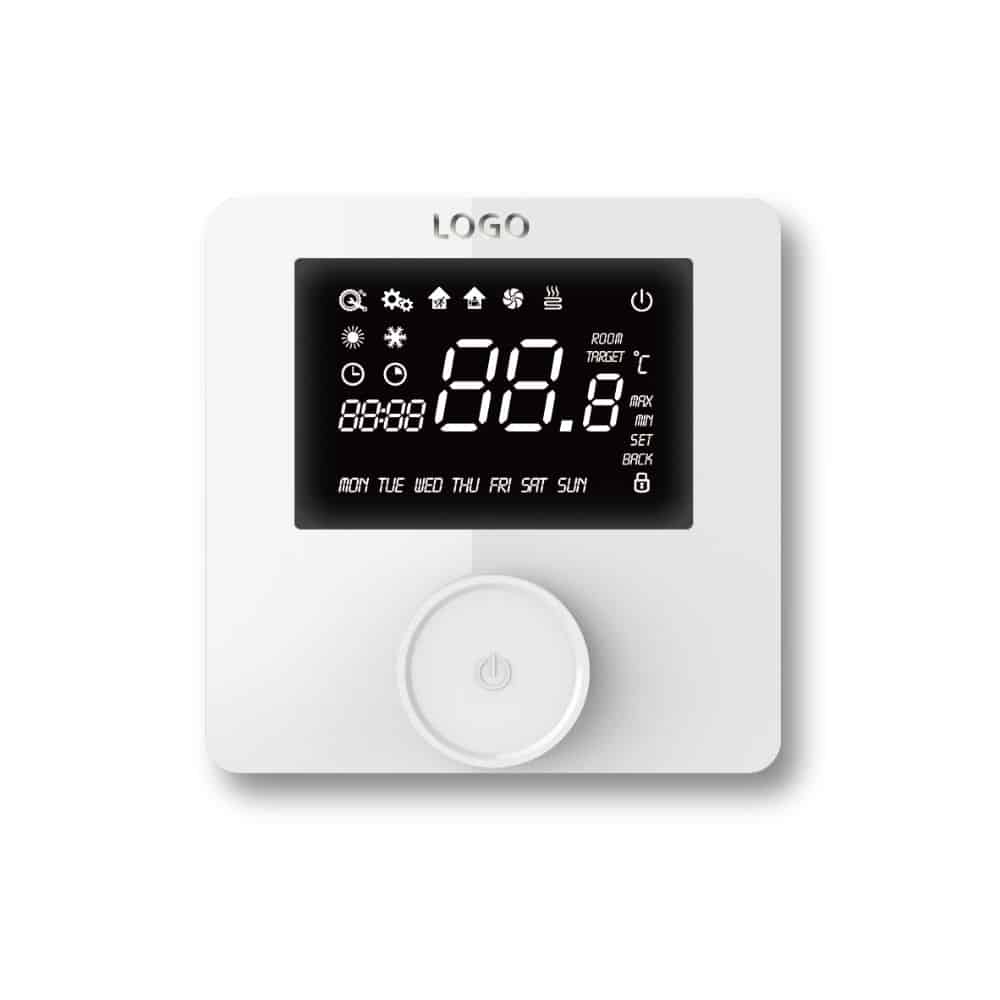
Our RT-X1 Ascent sits here, with a 7-day schedule at six time and temperature periods per day, which is enough resolution for a real household routine rather than a crude day and night split. The 5+2 arrangement also means a weekend pattern does not have to be programmed separately for each day.
Smart thermostats address the override problem by not relying on you to program them: they learn occupancy, or use your phone’s location to know when the house is empty. ENERGY STAR estimates that certified smart thermostats save around 8 percent of heating and cooling energy, which is a credible figure and rather less than the 10 to 15 percent sometimes claimed.
Where a smart thermostat is the wrong choice, and this rarely gets said:
- No C-wire. Covered below, and it is the most common obstacle in older US homes.
- Unreliable internet, which removes most of the value and can leave the wall interface degraded.
- A rental property, where the occupant will not use the app and the owner cannot rely on it.
- A heat pump with a thermostat that handles auxiliary heat badly. A smart thermostat that calls resistance heat aggressively on recovery can cost more than a dumb one that does not.
Our comparison of programmable room thermostat types goes into the categories in more depth, and room thermostat settings covers configuration.
The C-Wire: the US Installation Problem
If you are replacing a thermostat in an American home, check this before buying anything.
US thermostat wiring uses letter-coded conductors:
- R or Rh / Rc: 24 V power from the transformer
- W: heating call
- Y: cooling call, or compressor
- G: fan
- C: common, the return path that allows continuous power
- O/B: reversing valve, on heat pumps only
A traditional thermostat needs no C-wire, because it only closes contacts. A smart thermostat needs continuous power for its display, Wi-Fi and processor, and that requires the C terminal.
Plenty of older US homes were wired without one. Your options then: run a new cable, use an unused conductor in the existing cable if there is one, fit a C-wire adapter at the furnace, or choose a thermostat that does not require a common. What you should not do is rely on “power stealing”, where the thermostat draws through the heating circuit, because it causes intermittent relay chatter and short cycling on some systems.
Pull the old thermostat off the wall and photograph the terminals before you order. It takes two minutes and it determines which products are actually available to you.
Where the Thermostat Is Mounted
A thermostat measures the air at one point and controls the whole house from it, so a bad location produces a permanently uncomfortable house that no amount of adjustment fixes.
Avoid:
- Direct sunlight at any time of day, which makes the thermostat read warm and under-heat the house in winter.
- Exterior walls, which track outdoor temperature rather than room temperature.
- Near a supply register, where it feels the conditioned air rather than the room and short cycles.
- Kitchens, for obvious reasons, and bathrooms.
- Hallways and stairwells, which are rarely representative of the rooms people occupy.
- A wall with a duct or chimney behind it.
Aim for an interior wall in a regularly occupied room, roughly 5 feet above the floor, away from drafts and from lamps or electronics that give off heat. If the existing location is bad, a remote sensor is cheaper than relocating the wiring, and several thermostats support them.
Maintenance That Affects the Thermostat’s Job
A thermostat can only control what the system can deliver.
Change the air filter. The single most neglected item in forced-air systems. A clogged filter restricts airflow, which makes the system run longer to reach setpoint, and on a furnace can trip the high limit switch so it cycles on and off without heating the house. Monthly checks, replacement every one to three months depending on the filter and the household.
Keep supply and return registers clear. Furniture over a return starves the blower.
Have the system serviced annually, before the season rather than during it.
On hydronic systems, bleed radiators that are warm at the bottom and cold at the top, and check your thermostatic radiator valves are not stuck. This is where the European guidance genuinely applies.
Check the thermostat’s own calibration occasionally with a separate thermometer beside it. A unit reading two degrees out will hold the house two degrees off, and most thermostats have a calibration offset for exactly this.
Legom Room Thermostats
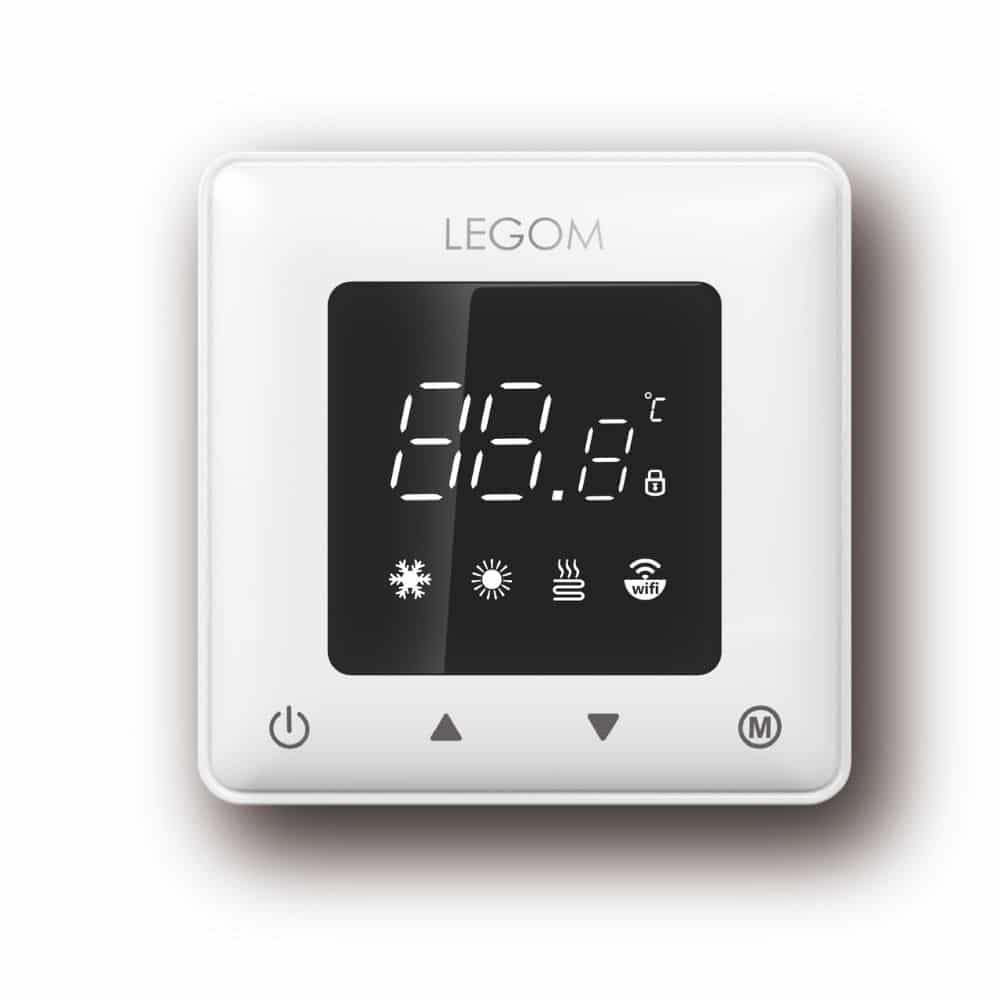
Jiaxing Legom Technology Co., Ltd. manufactures room thermostats and HVAC controls in Jiaxing, Zhejiang, supplying more than 90 countries.
Our room thermostat range covers four models:
- Apus (RT-A1 / RT-A2), in white and black, for residential underfloor heating and general room control.
- RT-X1 Ascent, programmable with a 7-day schedule at six periods per day, a 5 °C to 45 °C operating range and a 16 A switched live output, enough to drive a contactor directly.
- Volcano (RB-2305HT), 100 to 240 V at 50/60 Hz with valve outputs and dry contact terminals in an 86 mm housing. The wide input range suits markets where supply voltage is less stable.
- FC (FC1D), 100 to 240 V, for water-based underfloor heating and cooling, heat pump systems and four-pipe fan coil installations, with centralised multi-room control through our base stations.
Our strength is the hydronic side: thermostats working with manifolds, thermal actuators and wiring centres on underfloor heating and fan coil systems. If your US home is forced-air with a furnace and central AC, a thermostat designed for that market is the better fit, and we would say so rather than sell you the wrong product. Where the application is radiant floor, hydronic or fan coil, our range is built precisely for it.
We manufacture our own wax thermostatic elements rather than buying them in, which is what keeps sensing behaviour consistent across production runs.
For distributors and brands, our OEM and ODM service covers branding, display units and language, terminal layout and market documentation, and our background is in choosing an OEM thermostat manufacturer in China. For how we specify into other regions, see European thermostats and the role of a central heating room thermostat.
Frequently Asked Questions
What temperature should I set my thermostat to?
US Department of Energy guidance is 68 °F (20 °C) in winter while home and awake, and 78 °F (26 °C) in summer while home, with a setback while asleep or out. The 18 to 19 °C figure in British guidance is written for different housing and climate.
Should the fan be on AUTO or ON?
AUTO. ON runs the blower continuously, which is a substantial electrical load, and in humid weather it blows house air across a wet evaporator coil and re-evaporates the condensate back into the house, raising indoor humidity.
What is emergency heat and when should I use it?
It bypasses the heat pump and runs electric resistance elements instead, which cost considerably more to run. Use it only when the heat pump has failed and you need heat while waiting for a repair. On a cold day the thermostat brings in auxiliary heat automatically alongside the heat pump, which is cheaper and entirely different.
Does turning the thermostat up make the house heat faster?
No. A furnace has one output and runs until the setpoint is reached, so a higher setting only makes it run longer and overshoot. Set the temperature you want.
How far should I set the temperature back when out?
On a furnace, 7 to 10 °F is worth doing. On a heat pump, keep it shallow at 2 to 3 °F, or use a thermostat with proper heat pump recovery logic, because a deep setback triggers expensive auxiliary resistance heat on the way back up. On radiant floor heating, shallow or none, because the floor cannot recover quickly.
What is a C-wire and do I need one?
The common wire, which provides the return path for continuous 24 V power. Traditional thermostats do not need it; smart thermostats generally do, for the display, Wi-Fi and processor. Many older US homes lack one, so photograph your existing terminals before buying.
Do smart thermostats really save money?
ENERGY STAR estimates around 8 percent of heating and cooling energy for certified models. The real advantage over a programmable unit is that it does not depend on you maintaining a schedule, which is where programmable thermostats historically failed to deliver savings in practice.
Where should a thermostat be mounted?
An interior wall in a regularly occupied room, around 5 feet up, away from direct sunlight, exterior walls, supply registers, kitchens and heat-producing electronics. If the existing position is poor, a remote sensor is cheaper than moving the wiring.
Reviewed by Maggie Shen, Director at Legom, on October 22, 2026. This article was reviewed for technical accuracy, including the prevalence of forced-air and heat pump systems in US housing, US Department of Energy setpoint guidance in Fahrenheit, the humidity effect of continuous blower operation, the distinction between emergency heat and automatic auxiliary heat on a heat pump, why deep setback is counterproductive on heat pumps and high thermal mass systems, US thermostat wiring designations and the C-wire requirement, and the ENERGY STAR savings estimate for certified smart thermostats.