
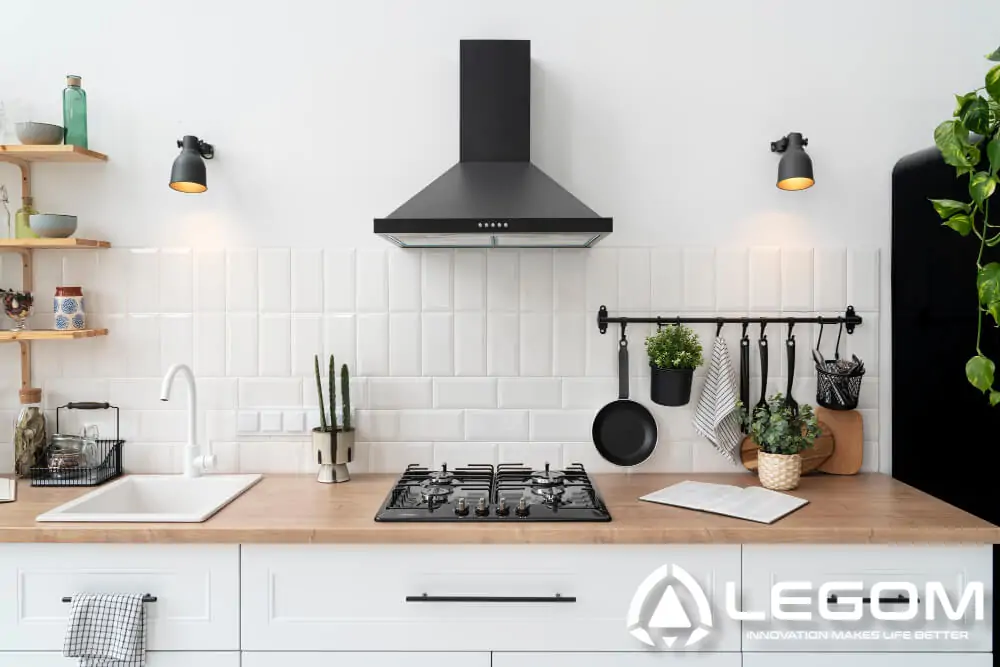
People worry about outdoor air quality and check the index before going for a run. Then they fry something for ten minutes with the window shut and expose themselves to concentrations that would close a school if they occurred outside.
Cooking is one of the largest sources of fine particulate in a home, and reducing PM2.5 from cooking is mostly a matter of a few habits that cost nothing, plus one piece of equipment that has to be the right type. This guide covers both: where the particles actually come from, which cooking methods produce the most, and the measures that genuinely reduce exposure rather than just moving the smell around.
How Cooking Produces PM2.5
PM2.5 means particulate matter 2.5 micrometres in diameter or smaller. For scale, a human hair is roughly 50 to 70 micrometres across, so a PM2.5 particle is somewhere around a twentieth to a thirtieth of that width. Far too small to see individually, and small enough to stay suspended in room air for hours rather than settling out.
Cooking generates it through three separate mechanisms, and they are worth separating because the remedies differ:
Fuel combustion. A gas burner is a combustion appliance operating inside your home without a flue. It produces nitrogen dioxide, carbon monoxide and ultrafine particles directly, before any food is involved. Electric and induction hobs produce none of this.
Oil breakdown. When cooking oil is heated past its smoke point, the fatty acids begin to decompose. That decomposition releases fine particulate and aldehydes, and the visible wisp of smoke from a pan is the point at which it is already happening.
Food emissions. Fats rendering out of meat, moisture flashing off at high heat, and the browning reactions that make food taste good all release particles and volatile organic compounds. The aroma of searing meat is partly a PM2.5 plume.
Once airborne, these particles are small enough to reach deep into the lungs and, in the finest fraction, to cross into the bloodstream. Repeated exposure is associated with respiratory irritation and inflammation, with worsened asthma, and over years with reduced lung function and increased cardiovascular risk. Our page on PM2.5 health effects covers the mechanism in more detail.
How Bad Does Kitchen Air Actually Get?
Worth putting numbers on it, because the scale surprises people.
Frying, searing and wok cooking can push kitchen PM2.5 into the hundreds of micrograms per cubic metre while the cooking is in progress. Compare that against the outdoor air quality bands: a 24-hour average of 55.5 to 125.4 µg/m³ is classified “Unhealthy”, and above 225.5 µg/m³ is “Hazardous”, the level at which authorities issue emergency advisories.
Kitchen concentrations are short bursts rather than 24-hour averages, so the comparison is not exact. But the point stands: for the twenty minutes you are cooking, the air next to the hob can be dirtier than the air on a severe haze day outside. And unlike a haze event, it happens every day, and nobody issues an advisory about it.
If you want the context on how those thresholds are set, see our explainer on the air quality index and what the numbers mean, and the comparison data in PM2.5 levels in major cities.
Which Cooking Methods Produce the Most
Roughly in descending order:
Deep frying and wok cooking. Large volumes of oil at high temperature, usually above the oil’s smoke point, with vigorous air movement to disperse the plume. The worst combination.
Searing, grilling and pan-frying meat. Fat renders out, hits the hot surface and smokes. Grilling over charcoal adds the fuel’s own combustion products on top.
Dry-frying spices. Small quantities but very high surface temperature, and the plume is almost entirely fine particulate.
Roasting and baking. Lower, because the oven encloses the plume and much of it vents as the oven cycles rather than into the room. Opening the door mid-cook releases it in one go.
Boiling and steaming. Lowest. Water vapour is not PM2.5, and the temperature stays at or below 100 °C, well under any oil’s smoke point.
Solid fuel cooking with wood or charcoal sits outside this ranking because it is in a different category entirely. Burning solid fuel indoors without a flue produces particulate concentrations far beyond anything a gas hob generates, and it remains one of the largest sources of household air pollution worldwide.
The Extractor Hood: Type Matters More Than Power
This is the most important section in the article, because a very common mistake makes the whole exercise pointless.
A ducted hood extracts the air to outside. Particles, gases, moisture and heat all leave the building. This works.
A recirculating hood does not. It pulls air through a grease filter and a charcoal filter, then blows it back into the kitchen. The grease filter catches droplets and the charcoal adsorbs some odour, which is why the kitchen smells better. The PM2.5 stays in the house.
So if your hood has no duct to the outside, it is not reducing your particulate exposure, whatever its extraction rating says. That is not a reason to rip it out, since it still handles grease and odour, but it does mean the particle problem needs solving another way, which the filtration section below covers.
If you are specifying or replacing a hood, duct it outside. It is the single highest-impact decision available.
Getting the Most From a Hood You Already Have
Four habits, all free, all more effective than most people expect:
Use the back burners. Capture efficiency differs substantially between front and back positions on a typical hood, because the plume from a front burner rises at the hood’s edge and much of it spills past into the room. The back burners sit under the centre of the capture area. Cooking the smokiest dish on the back burner is the cheapest intervention there is.
Switch the hood on before you start, and leave it running 10 to 15 minutes after you finish. The plume does not stop when the heat goes off. Hot oil, a hot pan and hot food continue emitting for a while, and that tail is exactly when most people switch the fan off and walk away.
Run it on a higher setting than feels necessary. People run hoods on low because of the noise. A plume that escapes the capture area is in the room for the rest of the evening.
Clean the grease filter. A clogged metal mesh filter restricts airflow, which drops the extraction rate well below the rated figure. Monthly in a kitchen that fries regularly.
Open a window on the far side of the room if you have one. An extract fan needs make-up air from somewhere, and if it cannot get it the fan simply runs against a sealed room and moves much less air than it should.
Cooking Habits That Reduce Emissions at Source
Capture and filtration deal with particles after they exist. These reduce how many are produced.
Match the oil to the temperature. The mechanism behind “cook at lower heat” is the oil’s smoke point. Past it, the oil decomposes and emits. Extra virgin olive oil and butter have relatively low smoke points and are poor choices for high-heat searing. Refined oils such as rice bran, refined peanut and avocado tolerate wok temperatures with much less breakdown. Choosing the right oil lets you keep the heat and cut the emissions.
Do not heat oil until it smokes. Visible smoke is the signal you have already gone past the point. If a recipe says to get the oil shimmering, that is the target, not smoking.
Lid on where the dish allows. A lid contains both the plume and the moisture.
Favour boiling, steaming and braising for a share of your cooking. Not a instruction to stop frying, just a note that the method you choose moves the exposure by an order of magnitude.
Keep the hob and the surrounding surfaces clean. Accumulated oil residue on burner surrounds and nearby walls scorches on each use and contributes its own smoke.
Never burn wood or charcoal indoors for cooking or heating unless it is a properly flued appliance designed for it.
If you are replacing a hob, consider induction. It removes the combustion source entirely, so the only emissions are from the food and the oil. For households with asthma or young children, that is a meaningful change rather than a marginal one. See indoor asthma triggers.
Air Filtration in the Kitchen
Filtration is the complement to extraction, not a substitute for it. An extractor removes the plume at source; a purifier cleans what escaped, and what has already spread into the rest of the home.
Two filter types, doing two different jobs:
HEPA captures the particulate. Worth correcting a common misstatement here: HEPA is specified at 0.3 microns because that size is the hardest to catch, not because it is the limit. Efficiency is higher both above and below it, so a HEPA filter handles particles considerably smaller than 0.3 microns better than it handles 0.3 micron ones. The US definition is 99.97% at 0.3 microns; EN 1822 class H13 is at least 99.95% measured at the most penetrating particle size.
Activated carbon handles the gases and the odour. The mechanism is adsorption, not absorption: molecules bind to the surface of the carbon’s pore structure rather than soaking into the material. That distinction matters because adsorption capacity is finite and the carbon saturates. When it does, it gives no external sign. It simply stops working, so replacement runs on a schedule rather than on appearance.
Cooking produces both particles and gases, so a kitchen-adjacent purifier needs both stages. A HEPA-only unit will clear the haze from the air and leave the smell of last night’s fish. Our comparison of HEPA and activated carbon filters covers both in depth.
One thing no filter does: remove carbon dioxide. A sealed kitchen with a gas hob running accumulates CO2 from the combustion as well as from the occupants, and that needs ventilation, not filtration. It is why fresh air units exist alongside purifiers rather than instead of them.
Legom Products for Kitchen and Adjacent Spaces
Legom manufactures air purification and ventilation equipment in Jiaxing, Zhejiang, supplying more than 90 countries. These are the units in our range that suit kitchen and open-plan living applications.
KJ200F-A01 Oxygen Source Negative Ion Purifier
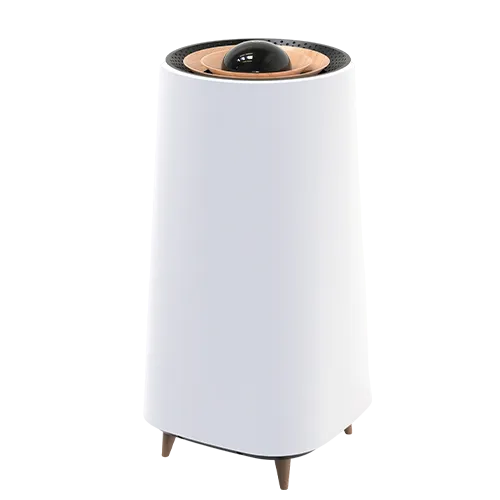
A free-standing unit for household rooms, including open-plan kitchen and dining spaces where the cooking plume spreads beyond the hob. Combines particulate filtration with ion purification, and handles both the fine particles from frying and the odour that lingers afterwards. The sensible placement is in the living area the kitchen opens onto rather than directly beside the hob, where the extractor should be doing the work.
XFQT-60-01S Ion Catalytic Fresh Air Purifier
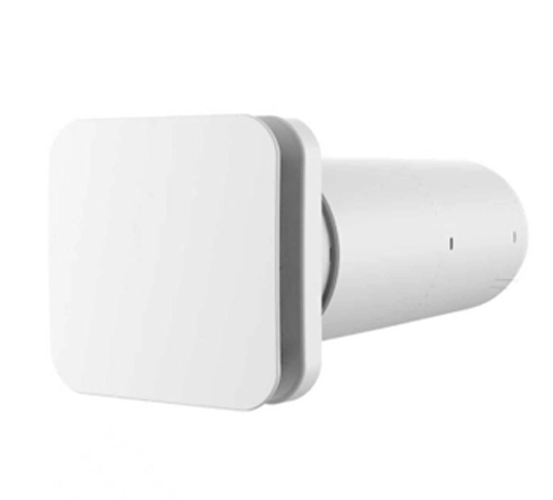
A wall-mounted fresh air unit, and the one that addresses the problem extraction alone cannot. Because it brings in filtered outside air rather than only recirculating, it supplies the make-up air an extractor needs while filtering what comes in. In a tightly sealed modern kitchen that combination matters more than purifier capacity on its own.
KJF-B01 Air Conditioner Companion
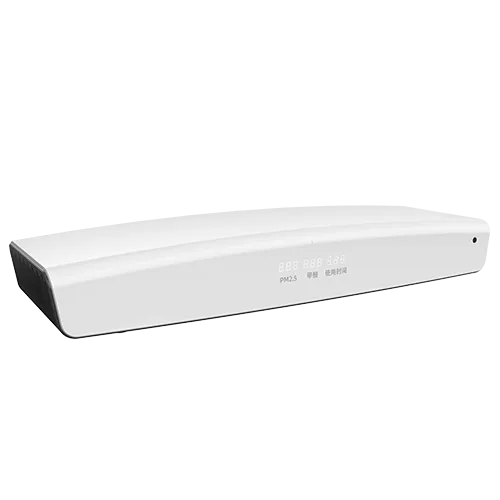
Designed to work alongside an air conditioner, filtering the air the AC is already circulating. To be clear about where it belongs: this is for the air-conditioned living or dining room next to the kitchen, catching the cooking plume that has drifted in, rather than for capture at the hob. In the open-plan layouts common in warm climates, that drift is where most of the household’s exposure actually happens.
KJF-B02 Air Conditioning Companion
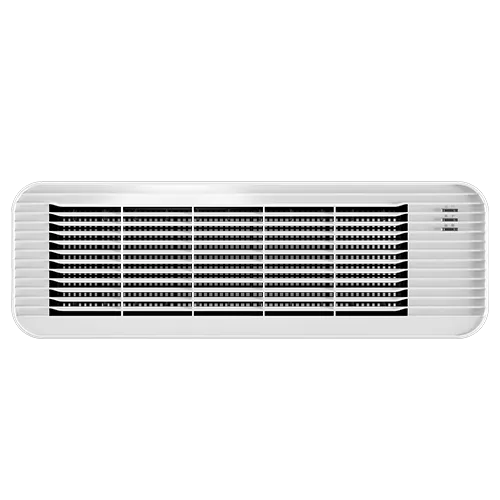
The same arrangement as the B01 with greater air movement capacity, for larger rooms and open-plan layouts where a single kitchen opens onto a substantial living space. Room volume is what decides between the two: a unit that cannot turn the air over often enough will not keep up with a cooking plume regardless of its filter class.
XFDD3-650-01J Campus Fresh Air Ventilator
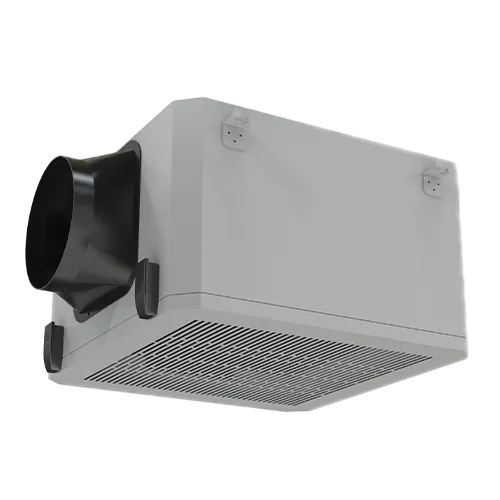
A high-volume fresh air ventilator for commercial duty: restaurant kitchens, canteens, and large domestic kitchens in substantial houses. Where a commercial extraction canopy is moving large volumes of air out, something has to bring an equivalent volume back in, filtered, or the extract system starves and the building goes into negative pressure. This is that side of the equation.
Our full air purifier range covers household, commercial and automotive applications. For specifying across a whole property, our note on HVAC control of temperature, humidity and air quality covers how ventilation and filtration work together. Distributors and installers should see our OEM and ODM service.
A Short Priority List
If you do nothing else, in this order:
- Check whether your hood ducts outside. If it recirculates, it is not removing particles and you need filtration as well.
- Cook on the back burners. Free, and it meaningfully improves capture.
- Hood on before you start, off 10 to 15 minutes after you finish.
- Match the oil to the heat, and never let it smoke.
- Clean the grease filter monthly if you fry regularly.
- Add a HEPA and carbon purifier in the room the kitchen opens onto.
- Consider induction next time the hob is replaced, particularly with asthma in the household.
Frequently Asked Questions
Does cooking really produce dangerous PM2.5?
Frying, searing and wok cooking can push kitchen PM2.5 into the hundreds of micrograms per cubic metre while cooking is in progress, which is higher than outdoor air on a severe pollution day. The exposures are short bursts rather than 24-hour averages, but they recur daily and go unnoticed because nobody issues an advisory for your kitchen.
Does a recirculating cooker hood remove PM2.5?
No. A recirculating hood filters grease and adsorbs some odour through a charcoal filter, then returns the air to the kitchen. The fine particles stay in the house. Only a hood ducted to outside removes them from the building.
Which burner should I use to reduce smoke?
The back burners. Capture efficiency is substantially better there because the plume rises under the centre of the hood, whereas a front burner’s plume rises at the hood’s edge and much of it spills into the room. It costs nothing and it is the most effective free change available.
Is a gas hob worse than electric for indoor air?
Yes, because it adds a second source. A gas burner is an unflued combustion appliance producing nitrogen dioxide, carbon monoxide and ultrafine particles in addition to whatever the food and oil emit. Electric and induction hobs produce only the cooking emissions.
Which cooking oil produces the least PM2.5?
Whichever one’s smoke point comfortably exceeds the temperature you are cooking at. Refined oils such as rice bran, refined peanut and avocado tolerate wok heat with far less breakdown than extra virgin olive oil or butter. The emissions come from the oil decomposing past its smoke point, so matching oil to method matters more than the oil’s type on its own.
Do I need HEPA or activated carbon for kitchen air?
Both. Cooking produces particles, which HEPA captures, and gases and odour, which it does not touch at all. Activated carbon handles the gases by adsorption. A HEPA-only unit will clear the visible haze and leave the smell.
How long should I run the extractor after cooking?
Ten to fifteen minutes. Hot oil, a hot pan and hot food keep emitting after the heat is off, and that tail is when most people switch the fan off. Running it on before you start helps too, by establishing airflow before the first plume appears.
Why does my extractor seem weak even on full power?
Usually a clogged grease filter, or no make-up air. An extract fan needs replacement air from somewhere, and in a tightly sealed kitchen it cannot get it, so it runs against a closed room and moves far less than its rated volume. Clean the filter and open a window on the far side, or fit a fresh air supply.
Reviewed by Maggie Shen, Director at Legom, on October 15, 2026. This article was reviewed for technical accuracy, including the particle size comparison against human hair diameter, the three distinct emission mechanisms in cooking, the difference between ducted and recirculating extraction, front and back burner capture efficiency, the role of oil smoke point, the correct interpretation of the 0.3 micron HEPA specification, and adsorption rather than absorption as the activated carbon mechanism.