

A fresh air system is a system that introduces outdoor air, purifies it, and imports it indoors to replace indoor air, maintaining the cleanliness and freshness of indoor air. Its main functions include air exchange, filtration and purification, temperature regulation, and humidity control. To understand more about the fresh air system,
The Necessity of Introducing Fresh Air in Daily Life
Do you know that people spend 85% of their time indoors? it is the reality of today’s lifestyle. Because people are indoors, air pollutants are very complex and constitute invisible killers to health. Only a fresh air system can solve this with one click. From a health perspective, introducing fresh air is necessary for life. If you are looking for a broader overview of solutions available for indoor air, you can also read our guide on finding the right indoor air quality solutions.
Existing Forms of Fresh Air Systems in the Current Market
I. In the Form of Ventilation
Unidirectional Flow Fresh Air System
Working principle: A unidirectional flow fresh air system uses air flow in only one direction, usually introducing fresh outdoor air into the room while discharging polluted indoor air. This system is relatively simple and commonly found in small residences or offices.
Applicable scenarios:
- Small apartments or residences. Suitable for living environments with small spaces. Installation and maintenance are relatively simple, and the cost is low.
- Offices. In places where people are concentrated and air circulation needs to be maintained, it can effectively improve air quality.
Advantages: Installation and maintenance are relatively simple, and the cost is low.
Bidirectional Flow Fresh Air System

XFDD3-360-01JP Full Heat Exchanger
Working principle: A bidirectional flow fresh air system handles air intake and exhaust simultaneously, both introducing fresh air and discharging polluted indoor air. This system is usually equipped with a heat exchanger, which can perform energy recovery and improve energy efficiency. The XFDD3-360-01JP Full Heat Exchanger is a representative product in this category, with 360m³/h capacity, 65% heat recovery rate, and zero consumables. You can also read our guide on home ventilation systems for fresh air all year round for more on ventilation setup options.
Applicable scenarios:
- Medium and large residences. Such as villas, which can meet larger space requirements. The bidirectional design provides the coverage and airflow management that a single unidirectional unit cannot.
- Commercial office buildings. Provides good ventilation effects and keeps indoor air fresh. It can also effectively regulate indoor temperature and humidity as part of the same process.
Advantages: Improves energy efficiency, reduces energy consumption, and can effectively regulate indoor temperature and humidity.
II. From the Form of Capture and Disinfection
Physical Form Using Filter Elements and Screens

XFDD3-650-01J Campus Fresh Air Ventilator
Working principle: Uses filter elements and screens to physically filter particulate matter, dust, pollen, and other pollutants in the air. Common ones include HEPA filters and activated carbon filters.
Applicable scenarios:
- Families. Especially suitable for families with people prone to allergies, it can effectively remove harmful substances. The physical filtration approach provides reliable baseline protection for everyday household use.
- Medical institutions and large public buildings. Ensures clean air in professional places such as hospitals. For high-occupancy environments such as campuses, the XFDD3-650-01J Campus Fresh Air Ventilator combines HEPA and negative ion filtration at 650m³/h with intelligent CO2 control and ceiling-mount installation.
Advantages: Effective physical filtration, improves air quality.
Chemical + Physical: Ionization Catalysis and Ionic Catalysis
-

XFQT-60-01S ion catalytic
-

KJF-B01 Air Conditioner Companion

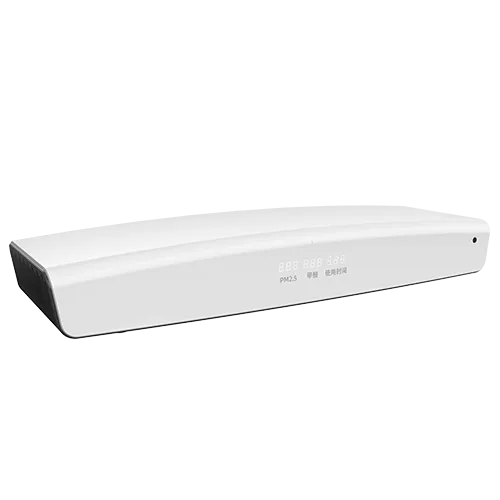
Working principle: Combines chemical reaction and physical capture technology. It generates reactive oxygen (OH·, O3, etc.) through ionization catalysis or ionic catalysis to react with harmful substances in the air, thereby decomposing and removing harmful gases (such as formaldehyde, benzene, etc.).
Applicable scenarios:
- Newly renovated houses. Quickly removes volatile organic compounds (VOCs) such as formaldehyde. The XFQT-60-01S Ion Catalytic Fresh Air Purifier is designed for this use case, delivering 60m³/h through-wall installation with formaldehyde removal, PM2.5 capture, and sterilization at just 12W.
- Offices. Eliminates odors in office areas. For workplaces with an existing air conditioning unit, the KJF-B01 Air Conditioner Companion installs directly inside the AC with no additional space required, eliminating over 99.99% of bacteria, viruses, and allergens and removing over 93.7% of formaldehyde with zero consumables.
Advantages: Can efficiently remove gaseous pollutants and improve air quality.
Physical: Ionization + Adsorption
Working principle: Uses ionization technology to charge tiny particles in the air, and then captures these particulate matters through electrostatic adsorption to reduce suspended matter in the air.
Applicable scenarios:
- In-car air purification. Used in cars to remove odors and fine particles. The compact design and absence of filter media make ionization-adsorption units practical for vehicle environments where space is at a premium.
- Offices and homes. Improves air freshness and comfort for users whose main concern is reducing fine particle concentration rather than eliminating biological threats.
Advantages: Can capture fine particulate matter and reduce PM2.5 concentration.
Physical: Pure Ionization

FLZ-MA-03 Car Negative Ion Purifier
Working principle: Directly treats pollutants in the air through ionization technology, generating negative ions that can effectively neutralize positive ion pollutants in the air, such as smoke and bacteria.
Applicable scenarios:
- Living areas. Such as bedrooms and living rooms, to create a healthy and comfortable environment. Can quickly freshen the air and reduce the spread of germs.
- In-car use. The FLZ-MA-03 Car Negative Ion Purifier clips to the AC grille and generates 250,000 ions/cm³ at just 1W with zero noise and no filter replacement. Public places such as schools and hospitals can also benefit from the fast air-freshening effect, though ozone output levels should always be verified before selecting any pure ionization product for occupied spaces.
Advantages: Can quickly freshen the air, improve air quality, and reduce the spread of germs.
Comparison of Advantages of Current Fresh Air System Forms
Each type of fresh air system has a different set of trade-offs. Here is a summary of the key differences between the four main approaches currently on the market.
- Pure physical form: Requires replacement of consumables, high resistance, no pure disinfection of bacteria and viruses (secondary pollution).
- Pure ionization form: Causes secondary harm (humans and machines cannot coexist).
- Ionization + Adsorption: Requires replacement of consumables, risk of secondary harm.
- Ionization + Catalysis: No consumables (cleaning is sufficient), disinfects bacteria, viruses, and allergens (high efficiency), quickly captures PM2.5, no secondary pollution (human-machine coexistence), quickly cleans indoor organic harmful substances and odors, low resistance (saves electricity).
| Technology Type | Requires Consumables | Kills Bacteria and Viruses | Secondary Pollution Risk | Energy Efficiency | Safe During Occupied Use |
|---|---|---|---|---|---|
| Pure physical filter | Yes | No | Yes | Low (high resistance) | Yes |
| Pure ionization | No | Yes | Yes (ozone) | Good | No |
| Ionization + adsorption | Yes | Partial | Yes (residual risk) | Moderate | Partial |
| Ionization + catalysis (Legom) | No (wash only) | Yes | No | High (low resistance) | Yes |
Problems Encountered by Products Currently on the Market
The problems encountered by products currently being made are the presence of consumables, secondary pollution, and high resistance (power consumption). The filter screen form cannot kill bacteria or viruses.
We mainly use ionization catalysis technology. Working principle: High voltage charging disinfects bacteria, viruses, and allergens, and decomposes ozone; low voltage captures particulate matter, and then fresh air replaces indoor organic harmful substances and odors, reducing carbon dioxide.
Frequently Asked Questions
What is a fresh air system?
A fresh air system is a system that introduces outdoor air, purifies it, and imports it indoors to replace the existing indoor air, maintaining cleanliness and freshness. Its main functions include air exchange, filtration and purification, temperature regulation, and humidity control. Unlike an air conditioner, which only recirculates air already inside the building, a fresh air system continuously brings in new air and expels the stale air, which is what keeps CO2 levels from rising and reduces the accumulation of indoor pollutants over time.
What is the difference between a unidirectional and a bidirectional fresh air system?
A unidirectional system moves air in one direction only, drawing fresh air in through one point while stale air exits passively. A bidirectional system manages both intake and exhaust simultaneously through dedicated channels. Most bidirectional systems also include a heat exchanger for energy recovery, which improves efficiency significantly in larger buildings. The unidirectional option is simpler and cheaper, while the bidirectional option is more suitable for villas, large residences, and commercial office buildings.
Why is ionization catalysis better than a HEPA filter for removing bacteria and viruses?
A HEPA filter traps particles physically but cannot kill biological threats. Bacteria and viruses that land on the filter surface remain alive and can potentially be released back into the air if the filter is not replaced on time. Ionization catalysis kills bacteria, viruses, and allergens through high-voltage charging, which eliminates the threat rather than just containing it. It also requires no filter replacement, only periodic washing of the collection components, which reduces ongoing maintenance cost and removes the risk of secondary pollution from a saturated filter.
Is pure ionization safe to use in an occupied room?
Pure ionization systems can produce ozone at levels that are not compatible with prolonged human exposure, which means the system and the room occupants generally cannot coexist safely during operation. This is the main practical limitation of pure ionization for everyday residential and commercial use. Ionization catalysis solves this problem by including a catalytic stage that decomposes the ozone before the treated air enters the room, making continuous occupied-space operation safe.
Which Legom product is best for removing formaldehyde in a newly renovated home?
The XFQT-60-01S Ion Catalytic Fresh Air Purifier is well-suited for this application. It uses ionization catalysis technology to break down formaldehyde and other VOCs chemically rather than just trapping them on a filter surface. It installs through the wall, draws outdoor fresh air in at 60m³/h, and also handles PM2.5 capture and sterilization at just 12W of power consumption. For offices with existing air conditioning, the KJF-B01 Air Conditioner Companion provides the same ionization catalysis function without requiring any additional space or wall installation.
Reviewed and updated by the LEGOM Technical Team on May 13, 2026. This article covers fresh air system types classified by ventilation method and purification technology, including a comparison of physical filtration, pure ionization, and ionization catalysis approaches, based on Legom’s experience as an air purifier and fresh air system manufacturer supplying indoor air quality solutions to partners in more than 90 countries worldwide.