

When having a water heater, we have to think about the maintenance like TP valve replacement cost. The euphoria might be at the beginning of purchasing something that is welcoming a new device. The budget might be allocated so much for buying. However, maintenance will be the next crucial thing that needs your attention.
It is worth understanding what this component actually does before looking at the numbers. A temperature and pressure relief valve, usually shortened to TP valve, is the safety device that opens automatically if the water inside the tank becomes too hot or the pressure climbs too high. If both rise unchecked and the valve fails to open, the tank itself can rupture. This is why the component is treated as critical rather than routine, and why replacing it correctly matters more than saving a small amount on the part.
TP Valve Replacement Cost Estimation
Knowing the cost of maintenance and part renewal is beneficial for your finances. Good budget preparation will not bother the other financial sector. You can save for a long time before the time for renewal has come. You can always save the maintenance budget for a sudden event like system failure. Whatever the purpose, saving is good for your financial security, including this room warmer maintenance.
Summarised from a number of sources, the range for this replacement typically starts at around $50 and reaches roughly $550 at the top end, with an average near $275 and $350 a commonly quoted figure. These are United States market ranges including the labour fee, and they shift over time and by region, so treat them as a guide rather than a fixed quote. Several factors affect the final expense.
The Brand
Each manufacturer has its standards and quality. The part also comes in various prices. Although there might be a global standard, each brand wants to give a touch of a unique masterpiece.
Labor Rate
Each area has different labor costs. The area with so many laborers might offer lower prices and vice versa.
The Season
If there are many replacement jobs in your area, the price might be higher. In this situation, the delay or lateness might happen because of the busy schedule.
The Age and Condition of the System
The fourth factor is the state of the water heater itself. On an older unit, the threaded connection where the valve sits may be corroded or seized, which turns a straightforward swap into a longer job and raises the labour component of the bill. Mineral scale is the usual culprit, particularly in hard water areas, and it can also mean the surrounding pipework needs attention at the same time. A valve on a young, well-maintained tank sits at the lower end of the cost range, while one on a heavily scaled fifteen-year-old unit sits nearer the top.
TP Valve Replacement Cost and the Frequency
Part or component renewal is not just once. One day, you have to repeat it. To estimate the TP valve replacement cost, it is better to know how many times you have to renew it. As this plays an important role in the heating system, there is no excuse for any error. Once an error occurs to the valve, you have to maintain it immediately. Its work is done every time, so delaying the repair time or the renewal time can cause system failure or discomfort for you and your family.
The suggested schedule for testing is once a year. Even if the device runs normally, the checking is still needed. In daily use, you have to notice the device’s behaviour, such as unusual sounds or any water leaking from the discharge pipe. Replacement is typically considered every three to five years, or sooner if the annual test reveals a problem.
Repair and replacement can sometimes be confusing to choose between. If the component malfunctions more than once within a short time of installation, that points to early replacement rather than repeated repair. The old belief that repair is always cheaper does not always hold. A simple way to decide: if the component is large and expensive, repair is usually the better route. For a smaller, inexpensive part where the repair fee approaches the price of a new one, replacement makes more sense. Always calculate before acting so that you do not spend more than necessary.
For a TP valve specifically, the calculation is rarely close. The part itself is inexpensive relative to the labour and relative to the consequences of failure, so replacement is almost always the correct decision once a fault appears.
Testing Your TP Valve Safely
An annual test is the standard recommendation, and it should not be skipped. The procedure is simple: place a bucket beneath the discharge pipe, lift the test lever on the valve briefly, and confirm that water flows out and then stops cleanly when the lever is released. A valve that produces no flow at all, or that continues to dribble afterwards and will not reseat, has failed and needs replacing.
There is a common concern that testing an old valve can cause it to leak afterwards, and this does sometimes happen when mineral deposits have built up around the seat. However, the conclusion to draw is not that testing should be avoided. A valve that fails during a controlled test in front of you was already unreliable, and discovering that with a bucket in hand is far better than discovering it during an actual overpressure event. If your valve leaks after testing, replace it rather than leaving it untested in future years.
Economize TP Valve Replacement Cost
There is always a way to cut the cost. DIYers can relate to this. If the replacement process is done by yourself, the cost that you have to spend is just the valve price. Here are the steps if you want to replace it by yourself.
- Stop the water supply. The water source should stop the supply to streamline the whole process.
- Shut down the power source (the electricity, or the gas supply on a gas unit), then allow the water in the tank to cool before going further. Release water from the tank (only a few litres) and detach the TP valve from the device. Be careful because there might be pressure or hot water left. If water escapes under pressure, it means not enough was drained in the previous step. Use a wrench or another tool with a similar function.
- Assemble the new component to the device. In installing the component, you might again need a wrench to tighten it so it adheres strongly. But remember to always control the tightness. Too tight will not be good for a device that deals with high temperature, pressure, and water.
- Confirm the discharge pipe is correctly refitted and directed safely downward, and check for any leakage.
- Reconnect the device to its power source and turn it on, then monitor the valve and connection as the tank reheats.
One caution is worth stating plainly. Because a TP valve is a safety device, an incorrectly sized or incorrectly installed replacement can be more dangerous than the worn valve it replaced. The new valve must match the original pressure rating and the tank’s requirements, and the discharge pipe must never be capped, reduced, or pointed where scalding water could injure someone. If you are not confident about the rating or the fitting, this is a job worth handing to a licensed professional, as covered in our article on why hiring professional plumbing services is essential.
Is the TP Valve Replacement Cost Worth It?
To sum up, the TP valve replacement cost starts from around $50. The factors that make the cost vary are the brand, the age and condition of the system, the labour cost, and the season. Before doing the part renewal, ask a professional plumber to evaluate the device’s condition, as they can estimate accurately.
They can also suggest beneficial advice for the next maintenance or replacement. A consultation does cost money, but it prevents unwanted additional costs in the future. Installing a component with professional help is generally the best decision, since it avoids the various errors that can occur during installation. In taking care of such a critical component, extra attention is genuinely warranted. So the TP valve replacement cost that you pay is well worth it for your safety. For more background on how this valve behaves and why it matters, see our article on TP valves on water heaters.
TP Valve Wholesale Price

If you’re interested in purchasing TP valves in bulk, please consider reaching out to the manufacturer directly. As a manufacturer of TP valves with Watermark certification, we assure you of the quality and compliance of our products. Our certification is a testament to our commitment to meeting high standards for water safety and efficiency. Wholesale pricing is competitive and depends on the model, pressure rating, and order volume, so the most reliable figure is a current quote for your specification. Check our TP valve on Alibaba for more references.
Legom 930004NT Temperature and Pressure Relief Valve
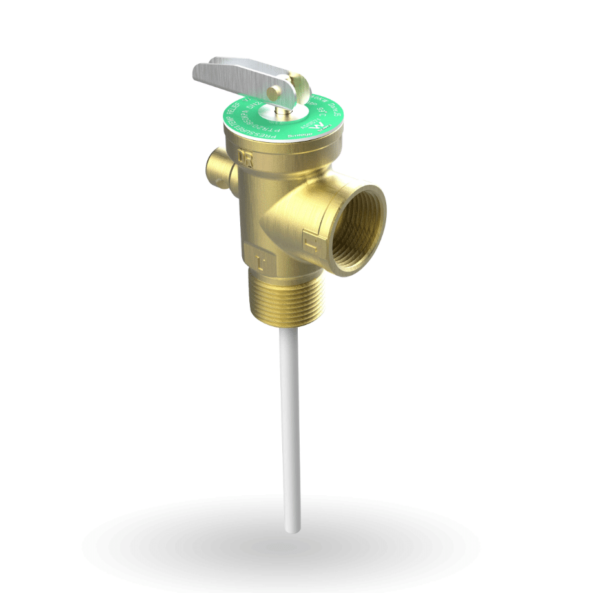
The 930004NT is a representative example from the Legom range, and its specification shows what to look for when comparing valves.
| Specification | 930004NT |
|---|---|
| Opening temperature | 93°C to 99°C |
| Resetting temperature | ≥70°C |
| Pressure ratings | 500, 600, 700, 850, 1000, 1200, 1400 kPa |
| Resetting pressure | ≥90% of opening pressure |
| Water-touching material | DZR brass |
| Sizes | DN15 (1/2″), DN20 (3/4″) |
| Expansion rating | DN15 (10kW), DN20 (46kW) |
| Standard | AS1357.1 |
Two details in that table matter when selecting a replacement. The pressure rating must match the tank it protects, which is why the valve is offered across seven ratings rather than one. The use of DZR brass, meaning dezincification-resistant brass, matters because a valve sits in constant contact with hot water for years, and ordinary brass can lose zinc over time and weaken. Compliance with AS1357.1 confirms the valve has been independently tested against a recognised standard for this application.
“The TP valve is the cheapest component on a water heater and the only one standing between a pressurised tank and a serious accident. What concerns me is how often people skip the annual test because they worry it will start leaking. If lifting the lever makes your valve leak, that valve was already compromised and you have just found out safely. The right response is to replace it, not to stop testing. When buyers ask us what to look for, I tell them three things: the correct pressure rating for the tank, dezincification-resistant brass, and compliance with a recognised standard. Those three cover almost everything that matters.”
— Maggie Shen, Director of Legom
This is a great opportunity for businesses looking to stock up on reliable and certified TP valves. The 930004NT sits within a wider Legom HVAC valve range covering pressure valves and thermostatic valves for hot water systems. We prioritize not only the quality of our products but also customer satisfaction and support. Contact us for more information or to discuss your specific needs; we’re here to help provide the best solutions for your requirements.
Frequently Asked Questions
How often should a TP valve be replaced?
Replacement is typically considered every three to five years, though the deciding factor is condition rather than age alone. An annual test tells you what you need to know: if the valve produces no flow when the lever is lifted, or fails to reseat cleanly afterwards and continues to drip, it should be replaced regardless of how old it is. Valves in hard water areas tend to need replacing sooner because mineral scale accumulates around the seat. If the same valve malfunctions more than once within a short period, replace rather than repair.
Should I test my TP valve, or will testing damage it?
You should test it, once a year, by placing a bucket under the discharge pipe and briefly lifting the test lever. It is true that an old valve can sometimes leak afterwards because scale has built up around the seat, and this makes some people reluctant to test at all. That reasoning is backwards. A valve that fails during a controlled test was already unreliable and would likely have failed when it was actually needed. Finding out with a bucket in your hand is far preferable to finding out during a genuine overpressure event, so test annually and replace any valve that does not reseat properly.
Can I replace a TP valve myself?
It is possible for a confident DIYer, provided the water supply and power or gas are shut off, the tank is allowed to cool, and enough water is drained first. However, the TP valve is a safety device, and an incorrectly rated or badly fitted replacement can be more dangerous than the worn valve it replaced. The new valve must match the tank’s required pressure rating, and the discharge pipe must be refitted properly, directed safely downward, and never capped or reduced. If there is any uncertainty about the rating or the connection, engaging a licensed plumber is the safer decision.
What pressure rating do I need for a replacement TP valve?
The replacement must match the rating specified for your water heater, which is normally printed on the tank’s data plate or the original valve body. Valves are produced across a range of ratings, for example 500 kPa through to 1400 kPa on the Legom 930004NT, precisely because tanks differ. Fitting a valve rated higher than the tank is designed for means the valve may not open before the tank reaches a dangerous pressure. Fitting one rated too low causes nuisance discharge. If you cannot read the original rating, have a professional confirm it rather than estimating.
What does a TP valve dripping mean?
Occasional discharge during heating can be normal thermal expansion, particularly in a closed system without an expansion vessel. Continuous or frequent dripping is not normal and points to one of three things: excessive pressure in the system, water temperature set too high, or a valve that has failed to reseat properly. It should be investigated rather than ignored, and the discharge pipe must never be plugged to stop the drip, since that removes the safety function entirely. A plumber can determine whether the cause is the valve itself, the thermostat setting, or system pressure.
Reviewed by Maggie Shen, Director at Legom, on July 22, 2026. This article on TP valve replacement cost was reviewed for technical accuracy and safety guidance, including annual testing practice and the 930004NT specification.