
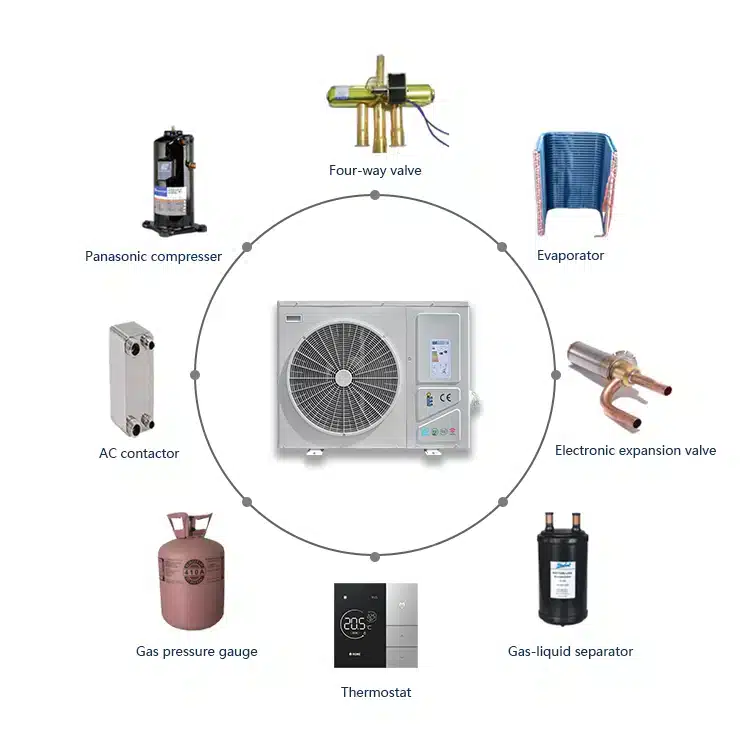
A heat pump contains around a dozen components, and understanding what each one does explains both how the system works and what tends to fail. This guide sets out the main parts of a heat pump, the role each plays in the refrigeration cycle, and why the monoblock arrangement integrates them all into a single outdoor unit.
The Main Heat Pump Components
Four components form the core refrigeration circuit. Everything else supports, protects, or controls them.
| Component | What it does | Role in the cycle |
|---|---|---|
| Compressor | Raises refrigerant pressure and temperature | Core, consumes most of the electricity |
| Evaporator (air-side heat exchanger) | Absorbs heat from outdoor air | Core, where heat enters the system |
| Condenser (water-side heat exchanger) | Transfers heat into the water circuit | Core, where heat leaves the system |
| Expansion valve | Drops refrigerant pressure sharply | Core, resets the cycle |
| Four-way reversing valve | Switches between heating and cooling | Reverses the direction of the cycle |
| Fan and motor | Moves air across the evaporator | Supplies the heat source |
| Gas-liquid separator | Prevents liquid reaching the compressor | Protection |
| Circulation pump | Moves water through the building circuit | Water side |
| Electric control box | Runs the control logic and protection | Control |
| Sensors and pressure gauges | Report conditions to the controller | Control and safety |
| Refrigerant | The medium that carries heat | Circulates through all of it |
How the Components Work Together
The refrigeration cycle has four stages, and each core component owns one of them.
1. Evaporation. Refrigerant at very low temperature and pressure enters the air-side heat exchanger. The fan draws outdoor air across it, and because the refrigerant is colder than the air, heat flows into the refrigerant and it evaporates into gas. This works even at sub-zero ambient temperatures, because the refrigerant is colder still.
2. Compression. The compressor raises the pressure of that gas, and pressure and temperature rise together. Heat collected across a large volume of cool air is now concentrated into a small volume of hot gas. This is the stage that consumes the electricity.
3. Condensation. The hot gas passes through the water-side plate heat exchanger, where it meets water from the building circuit. Heat transfers into the water, the refrigerant condenses back to liquid, and the warmed water is pumped into the building.
4. Expansion. The electronic expansion valve drops the pressure sharply, the refrigerant cools dramatically, and it returns to the evaporator to begin again.
Why efficiency exceeds 100%. No component in this list generates heat. The system transports heat that already exists in outdoor air, and electricity is spent on moving it rather than creating it. That is why a heat pump delivers three to four units of heat per unit of electricity, while anything that generates heat from fuel or electricity is limited to what that fuel or electricity contains. The comparison with a boiler is not a matter of degree; it is a different mechanism entirely.
The Components in Detail
Compressor
The heart of the system and the component that determines both efficiency and service life. It compresses refrigerant gas, raising its pressure and temperature so heat can be transferred effectively into the water circuit.
The type matters considerably. A fixed-speed compressor runs at full output or not at all, so it reaches the set point and shuts down, then restarts, repeatedly. Every start places mechanical and electrical stress on it.
A DC inverter compressor varies its speed to match actual demand, modulating steplessly rather than cycling. This improves seasonal efficiency substantially, because mild conditions make up most of the heating season, and it extends compressor life because start-up events are what cause most wear. Legom units use DC inverter twin rotary compressors with stepless modulation from 20% to 120% of nominal output.
Evaporator: the air-side heat exchanger
Where heat enters the system. Refrigerant passes through a coil while a fan draws outdoor air across hydrophilic aluminium fins, and heat flows from air into refrigerant.
The hydrophilic coating matters in cold climates. It encourages condensed water to sheet off rather than bead, which reduces frost adhesion and improves defrost performance. Surface area matters too, which is one reason larger units achieve better efficiency: more fin area means more effective heat extraction per unit of compressor work.
Condenser: the water-side heat exchanger
Where heat leaves the system. A plate heat exchanger brings hot refrigerant and circuit water into close thermal contact across thin stainless plates without mixing them. The compact plate design achieves high transfer efficiency in a small volume, which is part of what allows a monoblock unit to remain reasonably sized.
Electronic expansion valve
Controls refrigerant flow with precision, and this is where modern units gain efficiency over older designs.
A simple thermostatic expansion valve responds mechanically. An electronic expansion valve is driven by the control board using sensor feedback, allowing it to optimise refrigerant flow continuously as conditions change. That precision maintains stable performance across a wide range of outdoor temperatures rather than only at the design point.
Four-way reversing valve
The component that distinguishes a heat pump from an air conditioner, and it is worth understanding because the distinction is frequently misunderstood.
An air conditioner and a heat pump use the same refrigeration cycle with the same components. The four-way valve allows the refrigerant flow to be switched so the cycle runs in the opposite direction: instead of taking heat from inside and rejecting it outside, the unit takes heat from outside and delivers it inside.
That single valve is what makes one machine capable of both heating and cooling. Our comparison of heat pumps and air conditioners covers this in full.
Fan and fan motor
Moves outdoor air across the evaporator, supplying the heat source the system depends on. A DC brushless motor varies its speed to match compressor duty, which reduces both energy consumption and noise compared with a fixed-speed fan running flat out whenever the system operates.
Larger units may use twin fans. Beyond the additional airflow, this allows each fan to run at lower speed than a single fan moving the same volume, which is why the 16 kW Legom unit is only 4 dB(A) louder than the 5 kW despite delivering more than three times the output.
Gas-liquid separator
A protective component. Compressors are designed to compress gas, and liquid refrigerant entering the compressor causes immediate mechanical damage because liquids do not compress. The separator holds back any liquid that has not fully evaporated, allowing only gas through. It does nothing visible in normal operation and prevents an expensive failure in abnormal conditions.
Circulation pump
Moves water through the building circuit. Modern units use variable-speed pumps that adjust to demand rather than running at fixed speed, which reduces both energy consumption and noise.
Control box and sensors
The control board receives readings from NTC sensors positioned throughout the unit, monitoring refrigerant temperature at several points, water flow and return temperature, and outdoor ambient temperature. From those readings it manages compressor speed, expansion valve position, fan speed, and defrost timing.
Supporting components including the AC contactor, pressure gauges, and protection switches ensure safe operation and shut the unit down before conditions become damaging. Our guide to NTC sensors covers how the temperature sensing works.
Refrigerant
Not a mechanical part, but the medium that carries heat through the entire cycle, and its properties determine what the system can achieve.
R32 has a Global Warming Potential of 675 against 2088 for the older R410A it replaces, and requires a smaller charge for the same output. This matters commercially as well as environmentally: under the European F-Gas Regulation and equivalent rules elsewhere, high-GWP refrigerants face progressive quota restriction, which makes equipment charged with them harder and more expensive to service over time.
Monoblock and Split: How the Components Are Arranged
The same components can be packaged two ways, and the difference affects installation more than performance.
| Aspect | Monoblock | Split |
|---|---|---|
| Refrigerant circuit | Sealed entirely in the outdoor unit | Runs between outdoor and indoor units |
| Entering the building | Water pipes only | Refrigerant lines |
| Installation | Simpler, no refrigerant work on site | Requires certified refrigerant handling |
| Indoor space required | None for the unit itself | Space for the indoor module |
| Cold climate consideration | Water circuit needs freeze protection | Water components sit indoors |
The monoblock arrangement integrates every component into one outdoor unit, so only water pipes enter the building. That removes refrigerant work from the installation entirely, which matters because handling fluorinated refrigerants requires certification such as F-Gas in the European Union or EPA Section 608 in the United States.
The result is a system that is easier to install, easier to maintain, and self-contained, which is why monoblock units dominate residential air-to-water installations across Europe.
Which Components Fail, and What It Looks Like
Understanding the components is most useful when something stops working.
| Symptom | Component likely involved |
|---|---|
| No heating or cooling at all | Compressor, control board, or power supply |
| Heats but will not cool, or vice versa | Four-way reversing valve |
| Reduced output over time | Refrigerant loss, or fouled evaporator fins |
| Ice building up and not clearing | Defrost control or sensor fault |
| Unit runs but water stays cold | Circulation pump or water-side flow |
| Grinding or rough noise | Fan bearing or compressor wear |
| Temperature reading clearly wrong | NTC sensor drift or failure |
Anything involving the refrigerant circuit is certified work regardless of competence, since handling fluorinated refrigerants is legally restricted in most jurisdictions. Our guide to what you can repair yourself and what requires a professional covers where that line sits.
Why Component Quality Determines Performance
Two units with identical specifications on paper can perform quite differently in service, and the difference sits in the components.
Compressor. The single largest determinant of both efficiency and service life. Legom units use Panasonic and GMCC twin rotary compressors with full DC inverter control.
Fan motor. A DC brushless motor from an established manufacturer modulates smoothly and lasts. Legom units use NIDEC or SiGe motors.
Heat exchanger surface. More surface area and better coatings mean more heat extracted per unit of compressor work, which is why the largest unit in a range is sometimes the most efficient rather than the least.
Control sophistication. An electronic expansion valve with good sensor feedback and intelligent defrost logic extracts substantially more from the same mechanical components than basic control does.
Extreme Weather and Why Heat Pumps Suit It
Extreme weather has become more visible in recent years. In early 2026, Moscow recorded its heaviest snowfall in more than 200 years, with accumulation reaching 60 centimetres and paralysing transport. Around the same period, powerful winter storms swept the northeastern United States, forcing travel bans in major cities.
Conditions like these are difficult to manage with equipment designed for one function. An air conditioner handles summer and does nothing in winter. A boiler handles winter and does nothing in summer. A heat pump, by virtue of its four-way valve, covers both from one installation.
Cold-weather capability has improved substantially as well. Legom heat pumps are engineered to operate at ambient temperatures down to -35°C, sustained by inverter compressor speed compensation and demand-based defrosting. Output does decline as temperature falls, which is unavoidable physics for any air source unit, so cold-climate projects should be sized against local design temperature rather than the nominal rating.
On efficiency, an air source heat pump delivers three to four units of heat per unit of electricity, against one for direct electric heating. That is the source of the substantial running cost difference frequently quoted, and it comes from the mechanism rather than from any single component.
“The component people underestimate is the expansion valve. Everyone asks about the compressor, and fairly, because it is the expensive part. But an electronic expansion valve with proper sensor feedback is what lets the system stay efficient across the whole range of outdoor conditions rather than only at the temperature it was tested at. A unit with a good compressor and crude expansion control will look fine on a datasheet and disappoint across a real winter. That is one of the reasons two units with the same headline COP can behave quite differently once installed.”
— Maggie Shen, Director of Legom
Heat Pump Manufacturer and Supplier in China

Legom is an HVAC manufacturer and supplier based in Jiaxing, Zhejiang Province, specialising in air source monoblock heat pump systems. The range covers four capacities with more than ten cabinet colour options to suit different project requirements.
| Parameter | 5 kW | 6 kW | 9 kW | 16 kW |
|---|---|---|---|---|
| Heating range | 2.0–6.0 kW | 3.0–8.0 kW | 3.5–10.0 kW | 6.5–18.0 kW |
| COP at A7/W35 | 4.5 | 4.42 | 4.46 | 4.53 |
| Compressor | DC inverter twin rotary | DC inverter twin rotary | DC inverter twin rotary | DC inverter twin rotary |
| Fan quantity | 1 | 1 | 1 | 2 |
| Minimum ambient | -35°C | -35°C | -35°C | -35°C |
Legom supplies partners in more than 90 countries with production capacity reaching 600 units per day, maintaining supply stability and delivery efficiency. All products are packaged for transport and designed for straightforward installation on arrival. OEM and ODM services are available across the range.
Frequently Asked Questions
What are the main components of a heat pump?
Four form the core refrigeration circuit: the compressor, which raises refrigerant pressure and temperature; the evaporator or air-side heat exchanger, which absorbs heat from outdoor air; the condenser or water-side heat exchanger, which transfers that heat into the water circuit; and the expansion valve, which drops pressure to reset the cycle. Supporting components include the four-way reversing valve, fan and motor, gas-liquid separator, circulation pump, control box, sensors, and the refrigerant itself.
What does the four-way valve do?
It reverses the direction of refrigerant flow, allowing the same machine to both heat and cool. This is the component that distinguishes a heat pump from an air conditioner: both use identical refrigeration cycles with the same compressor, refrigerant, and heat exchangers, but only the heat pump can run that cycle in either direction. In heating mode it takes heat from outdoor air and delivers it inside; in cooling mode the reverse.
Which heat pump component is most important?
The compressor is the largest single determinant of efficiency and service life, and it is the most expensive part. However, the expansion valve is frequently underestimated: an electronic expansion valve with good sensor feedback maintains efficiency across the whole range of outdoor conditions rather than only at the design point. A unit with an excellent compressor and crude expansion control can look strong on a datasheet and disappoint across a real winter.
What is the difference between a monoblock and a split heat pump?
Where the refrigerant circuit sits. In a monoblock, every component including the refrigerant circuit is sealed within the outdoor unit, so only water pipes enter the building. This removes refrigerant handling from the installation, which is certified work in most jurisdictions. In a split system, refrigerant lines run between outdoor and indoor units, which requires a certified technician but removes freeze risk from the water circuit since the water components sit indoors.
Why does a heat pump deliver more energy than it consumes?
Because no component generates heat. The system transports heat that already exists in outdoor air, and electricity is spent moving it rather than creating it. That is why a heat pump delivers three to four units of heat per unit of electricity, while anything generating heat from fuel or electricity is limited by what that input contains. Comparing a heat pump to a boiler on efficiency is comparing two different mechanisms rather than two degrees of the same one.
What is a gas-liquid separator for?
Protecting the compressor. Compressors are designed to compress gas, and liquid refrigerant entering one causes immediate mechanical damage because liquids do not compress. The separator holds back any refrigerant that has not fully evaporated, allowing only gas through to the compressor. It does nothing visible during normal operation and prevents an expensive failure when conditions are abnormal, which is exactly what a protective component should do.
Why is the refrigerant type important?
Both environmentally and commercially. R32 has a Global Warming Potential of 675 against 2088 for the older R410A, and requires a smaller charge for the same output. The commercial consequence is that under the European F-Gas Regulation and equivalent rules elsewhere, high-GWP refrigerants face progressive quota restriction, which makes equipment charged with them harder and more expensive to service over time, independently of its mechanical condition.
Can I repair heat pump components myself?
Some, but not the ones that matter most. Cleaning debris from around the outdoor unit and keeping the evaporator fins clear are within reach of an owner. Anything involving the sealed refrigerant circuit, meaning the compressor, expansion valve, heat exchangers, or four-way valve, requires certification such as F-Gas or EPA Section 608 in most jurisdictions, and in many markets refrigerant cannot legally be purchased without it.
Reviewed by Maggie Shen, Director at Legom, on August 25, 2026. This guide to heat pump components was reviewed for technical accuracy, including the role of each component in the refrigeration cycle and the distinction between heat transport and heat generation.