
In recent years as this article is updated in 2026, extreme weather conditions have become more visible and disruptive across many parts of the world. In early 2026, Moscow recorded its heaviest snowfall in more than 200 years, with snow accumulation reaching up to 60 centimeters and paralyzing transportation across the city. Around the same period, powerful winter storms swept across the northeastern United States, forcing travel bans in major cities such as New York.
These events highlight how temperature extremes—both intense cold and sudden weather shifts—are becoming increasingly difficult to manage using traditional solutions alone. Insulation and conventional air conditioning systems are often no longer sufficient to maintain stable indoor comfort during prolonged or extreme conditions.
To address both heating and cooling challenges within a single system, many property owners are now turning to heat pump technology. Unlike conventional systems designed for only one function, heat pumps are built to respond flexibly to changing temperatures throughout the year.
Even when the temperature outside drops below zero degrees Celsius, a heat pump can still operate efficiently. In addition, the appearance of heat pump products today varies widely. Some come with compact and futuristic designs, while others look elegant and luxurious, resembling modern air conditioners. Many models are equipped with multi-purpose remote controls and are available in various color choices.
A heat pump can make the inside of a room cool during summer and warm during cold seasons. At first glance, the way this pump works is similar to an air conditioner. However, the main difference is that a heat pump is equipped with a reversing valve. This valve allows the heat pump not only to cool a room but also to heat it, depending on the direction of the airflow and outdoor conditions.
Contents
Heat Pump as the Solution to Extreme Unpredictable Weather
Global warming and human behavior that are far from sustainable living have created extraordinary impacts on the environment. It has become increasingly difficult to predict weather conditions. One day, you plan a barbecue party and suddenly the pleasant weather turns gloomy. On another occasion, you head to the sea for surfing, but a storm occurs without warning.
The next day, you may have to cancel a beach volleyball match because extreme heat replaces what was expected to be a peaceful sunny day. Those who stay indoors are no less affected by this weather uncertainty. Air conditioners are suitable in summer, but often cannot fully relieve extreme heat. This raises an important question—what happens during winter?
A heat pump becomes one of the most appropriate solutions to deal with this unpredictable weather. What makes it even more appealing is energy efficiency. An air source heat pump can save up to 70 percent more energy for heating air or water compared to conventional electric heaters.
Heat pump products from certain manufacturers use high-efficiency DC inverter compressors. The fan motor is also DC brushless, allowing automatic speed adjustment based on actual user load. This ensures energy consumption remains efficient without excessive compressor or fan usage.
Valuable Components of Heat Pump
Electricity bills tend to soar when extreme temperatures occur. Many people experience this issue, but some have found a solution by installing a heat pump. Before deciding on a specific brand, many consumers face difficulties in choosing the right type of air source heat pump for their property projects.
Generally, choices fall into two main categories: monoblock and split heat pumps. Each system has its own advantages depending on how it works. However, the monoblock system has proven itself as one of the most effective solutions for protecting properties from uncomfortable and unsuitable indoor temperatures.
A monoblock heat pump consists of key components such as a compressor, four-way valve, compressor drive, reservoir, heat exchanger, electric control box, auxiliary expansion valve, and axial flow fan blade. Additional components may include an economizer, main expansion valve, high-pressure gauge, DC motor, exhaust port, and suction port. The working principle of a monoblock heat pump is often compared to industrial steam boiler systems seen in factories.
This one-block system means all components are integrated into a single outdoor unit, installed outside the property.
Heat Pump System Components Explained
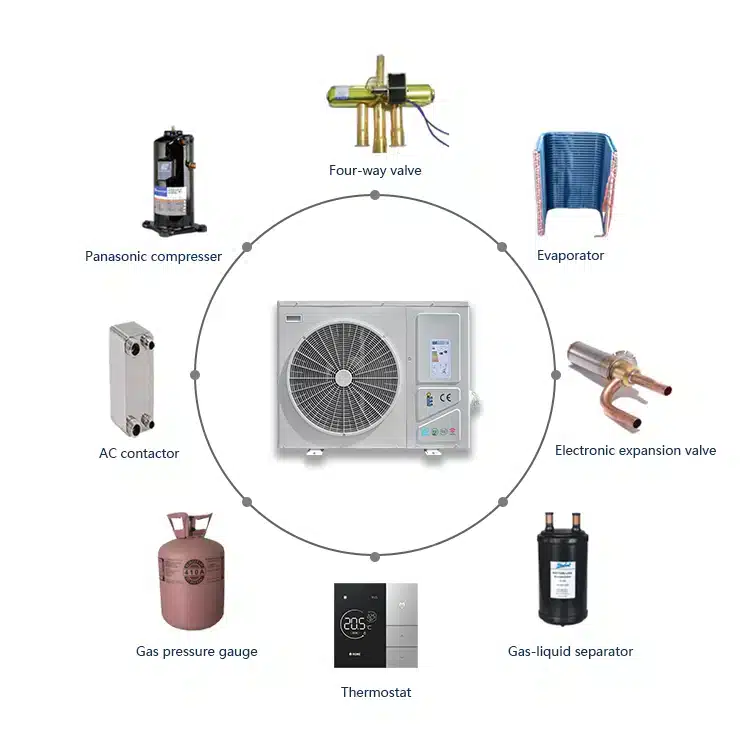
Air source monoblock heat pump components diagram including compressor, evaporator, four-way valve, and expansion valve
To better understand how a monoblock heat pump works, it is important to recognize the key components inside the system. As shown in the diagram above, all major parts are combined into one complete unit, making the system compact and efficient.
The compressor plays a vital role by compressing the refrigerant and increasing its temperature so heat can be transferred effectively. The four-way valve allows the heat pump to switch between heating and cooling modes, making it suitable for both summer and winter use. Meanwhile, the evaporator absorbs heat from the surrounding air, even when outdoor temperatures are very low.
The electronic expansion valve controls refrigerant flow with high precision to maintain stable performance and energy efficiency. A gas-liquid separator protects the compressor by preventing liquid refrigerant from entering the system. Supporting components such as the thermostat, AC contactor, and pressure gauge help ensure safety, accurate temperature control, and smooth operation.
By integrating all these components into one outdoor unit, the monoblock heat pump system becomes easier to install, easier to maintain, and more reliable for long-term operation in extreme and unpredictable weather conditions.
The Benefits of a Monoblock Heat Pump System
People are becoming more aware of how heat pumps work. Even when the outdoor temperature is very low, a monoblock heat pump can still extract usable heat energy from the surrounding air. The system works by transferring this heat energy to the heat exchange surface, where the refrigerant evaporates.
Next, the compressor increases the pressure of the gas, which also raises its temperature. The heated gas then passes through the internal heat exchange surface, distributing warmth throughout the interior of the property. This heat can also be directed to a central heating system if required.
Overall, many people prefer monoblock heat pump systems because they are easy to install, easy to maintain, self-contained, and designed as an all-in-one solution.
Heat Pump Manufacturer and Supplier in China

Legom is a professional HVAC manufacturer and supplier based in China, specializing in air source monoblock heat pump systems. The company offers a wide range of models designed for heating applications, with more than ten color options available to suit different project requirements.
Legom supplies products to more than 90 countries and works with hundreds of OEM and ODM business partners worldwide. With production capacity reaching up to 600 units per day, supply stability and delivery efficiency are maintained. All products are packaged properly and designed for easy installation upon arrival.
If you are searching for an efficient solution to heat or cool your property amid extreme and unpredictable weather conditions, heat pump technology is well worth exploring.
Reviewed by HVAC technical specialists for accuracy and compliance.
Last updated: 23 February 2026