
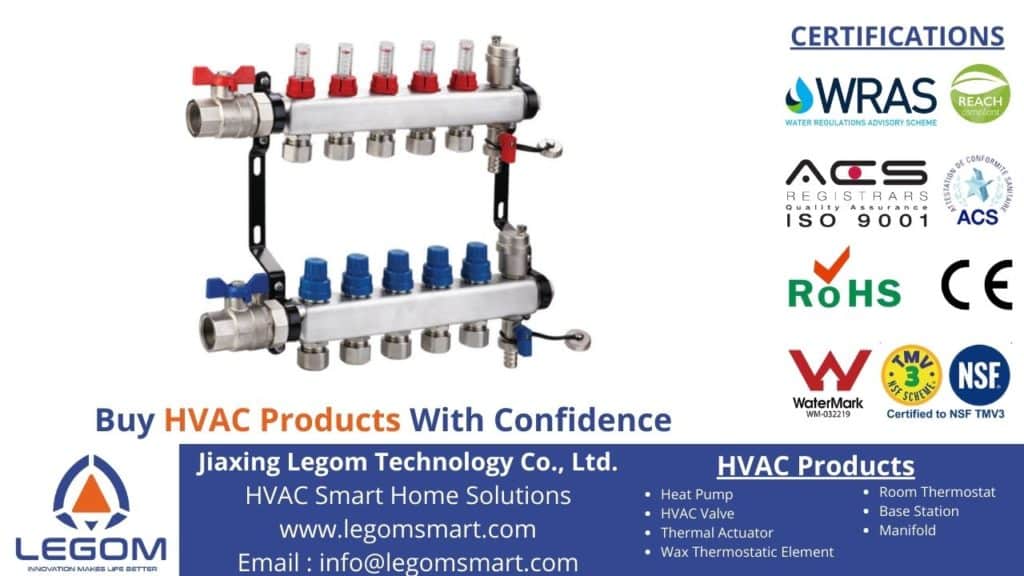
When we want to choose material for a hydronic manifold or any type of heating manifold, we often inevitably face debates with those around us. Some suggest brass manifolds for certain reasons, while others highly recommend a stainless steel manifold. On the other hand, because many underfloor heating systems traditionally use brass components, many people still want brass manifolds to be part of the installation. So, what will you do then?
Have you managed to get out of this debate? The truth is, you can use different materials for a manifold because each material has its own advantages and disadvantages. However, stainless steel manifold often sits in the middle position—offering stronger corrosion resistance and higher durability, while maintaining stable performance compared to common brass manifolds in long-term hydronic systems.
When you start considering a 304 stainless steel manifold, the debate usually becomes much clearer.
Contents
- 1 Why Stainless Steel Manifold 304
- 2 Durability of Stainless Steel Manifold
- 3 Ease of Fabrication
- 4 Ease of Maintenance
- 5 Why People Choose Brass, Nickel-Plated Brass, or Stainless Steel Manifolds
- 6 Stainless Steel Manifold vs Brass Manifold (Legom Technical Comparison)
- 7 Solution to System Reliability with Stainless Steel Manifold
- 8 Underfloor Heating Applications
- 9 Stainless Steel Manifold Manufacturer
Why Stainless Steel Manifold 304
Stainless steel is a material that is widely available around us. From nuts, bolts, storage tanks, exhaust components, hose clamps, to various industrial and household tools, stainless steel is known for its ability to withstand corrosion for many years.
In general, there are two commonly used stainless steel grades for manifold applications: 304 and 316. Among them, 304 stainless steel is the most widely used worldwide. Its balanced chromium and nickel content provides good corrosion resistance while maintaining cost efficiency. This is why 304 stainless steel is commonly used in piping systems, hardware manufacturing, and stainless steel manifolds for hydronic heating and water distribution systems.
Once you understand how 304 stainless steel performs in real installations, it becomes difficult to switch back to other materials.
Durability of Stainless Steel Manifold
One of the main advantages of a stainless steel manifold is its durability. Stainless steel contains chromium, which forms a protective oxide layer on the surface. This layer slows down corrosion and protects the material even in continuous water circulation systems.
Compared to brass, stainless steel provides better resistance to oxidation and long-term material fatigue. This makes it suitable for underfloor heating installations where the manifold operates continuously for many years.
Ease of Fabrication
Stainless steel is relatively easy to fabricate and can be formed into precise manifold designs. It performs well under pressure and temperature variation, which is important for hydronic heating systems.
In underfloor heating applications, stainless steel manifolds maintain structural stability even when exposed to repeated heating and cooling cycles.
Ease of Maintenance
Although stainless steel manifolds are highly durable, regular inspection and basic maintenance are still recommended. The advantage is that stainless steel is easy to clean, resistant to internal scaling, and maintains a clean appearance over time.
From an operational perspective, stainless steel manifolds help maintain system efficiency and reduce the need for frequent component replacement.
Why People Choose Brass, Nickel-Plated Brass, or Stainless Steel Manifolds
Different hydronic systems have different priorities. Below is a general comparison explaining why people choose each material.
| Decision Factor | Brass Manifold | Nickel-Plated Brass Manifold | Stainless Steel Manifold |
|---|---|---|---|
| Base Material | HPb 59-1 Brass | HPb 59-1 Brass with nickel coating | 304 Stainless Steel |
| Surface Protection | Natural brass surface | Nickel coating for added protection | Chromium-rich oxide layer (natural) |
| Corrosion Resistance | Good in normal water systems | Better than raw brass | Excellent, internal and external |
| Wear Resistance | Moderate | Improved surface hardness | Very high |
| Flow Stability Over Time | Can degrade over time | More stable than raw brass | Very stable long-term |
| Maintenance Requirement | Low in clean systems | Low if coating remains intact | Very low |
| Risk of Surface Damage | Low | Medium if coating is scratched | Very low |
| Installation Environment | Residential underfloor heating | Residential & commercial hydronic systems | Commercial, industrial, large hydronic systems |
| Cost Level | Lowest | Medium | Higher initial cost |
| Expected Service Life | Good in controlled environments | Longer than brass | Longest overall |
| Typical Buyer Preference | Cost-focused installations | Balanced performance and appearance | Long-term reliability and performance |
Nickel-plated brass manifolds are still brass at their core. The nickel layer improves appearance and surface corrosion resistance, but if the coating is damaged, the exposed brass behaves like a standard brass manifold. Stainless steel, on the other hand, does not rely on surface coating for protection.
-

M-B32 Brass Manifold for underfloor heating
-
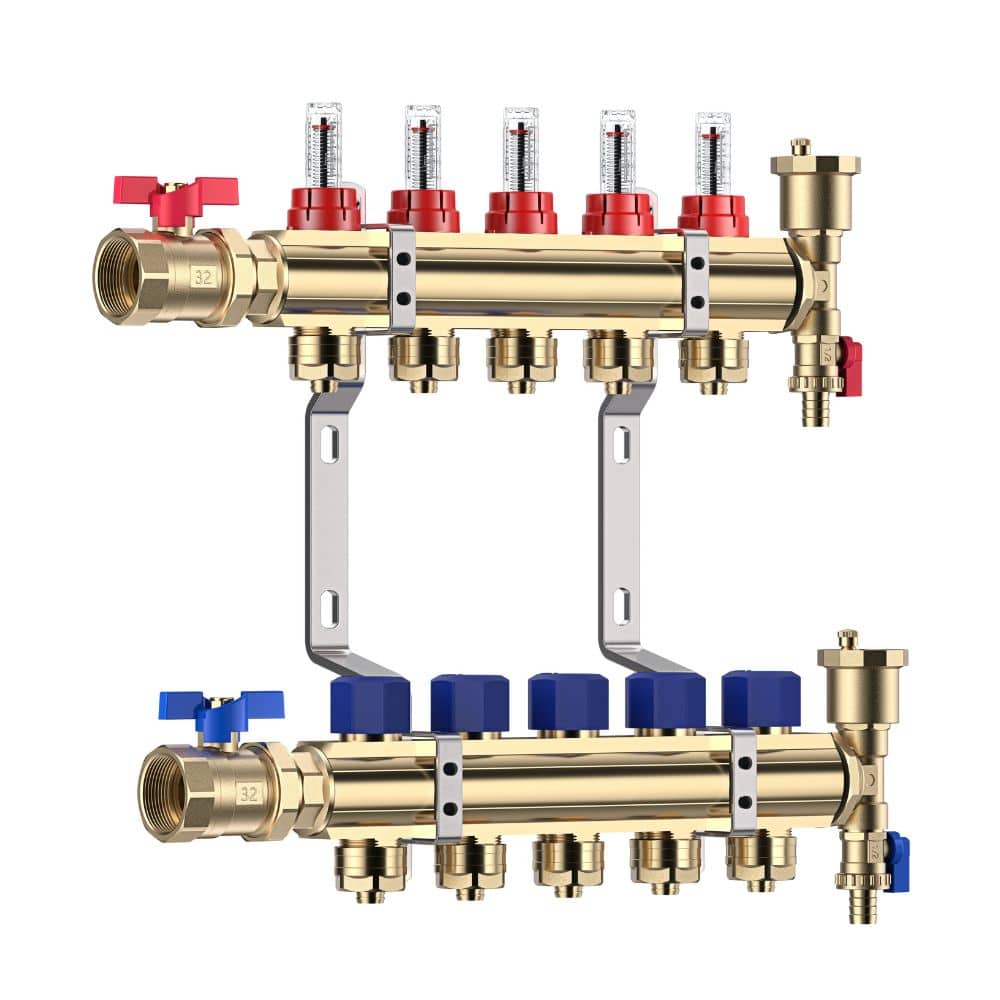
M-BN32 Brass Nickel Plated Manifold floor heating
-
M-S32 Stainless Steel Manifold hydronic floor heating


Stainless Steel Manifold vs Brass Manifold (Legom Technical Comparison)
To better understand the practical difference, below is a comparison based on actual Legom product specifications used in underfloor heating systems.
| Specification | Legom Stainless Steel Manifold (M-S32) | Legom Brass Manifold (M-B32) |
|---|---|---|
| Main Material | 304 Stainless Steel | HPb 59-1 Brass |
| Surface Treatment | Chromium-Rich Oxide Film | Fine Polishing & Baking Paint / Nickel Plated |
| Connection Specification | F1″ × M3/4″ | F1″ × M3/4″ |
| Maximum Working Pressure | 16 bar | 16 bar |
| Working Temperature | 110 ℃ | 110 ℃ |
| Working Medium | Water | Water |
| Max. Flow Rate (Main Pipe) | 20 kv (m³/h) | 12 kv (m³/h) |
| Max. Flow Rate (Branch Pipe) | 1.5 kv (m³/h) | 1.5 kv (m³/h) |
| Branches | 2–12 | 2–9 |
| Eurocone | 20×2.0, 16×2.0 | 20×2.0, 16×2.0 |
| Distance Between Branches | 50 mm | 50 mm |
The higher main pipe flow rate of the stainless steel manifold makes it more suitable for larger underfloor heating systems requiring stable and even heat distribution.
Solution to System Reliability with Stainless Steel Manifold
At this point, the debate becomes simpler. While brass and nickel-plated brass manifolds are still widely used, a stainless steel manifold offers stronger long-term reliability for hydronic heating systems.
Brass manifolds may experience internal wear or flow limitation over time, especially in larger systems. Stainless steel manifolds, when properly applied, can maintain performance for more than 10 years with minimal degradation.
Underfloor Heating Applications
In underfloor heating systems, the manifold plays a central role in distributing heated water evenly across each loop. Stainless steel manifolds are often preferred for larger or multi-zone systems because they handle continuous circulation and temperature variation more consistently.
With proper water treatment and regular inspection, stainless steel manifolds provide stable performance and long service life in residential and commercial underfloor heating installations.
Stainless Steel Manifold Manufacturer
Today, many stainless steel manifold products are available for hydronic heating systems. However, buyers should look beyond price and focus on material quality, manufacturing experience, and application knowledge.
Legom develops stainless steel manifolds using 304 stainless steel, designed for durability, stable flow performance, and ease of installation. With experience across underfloor heating and hydronic projects worldwide, Legom focuses on delivering reliable solutions that support long-term system performance.
Understanding your system requirements and choosing the right manifold material will help ensure efficiency, durability, and operational stability.
Last technical review: 4 February 2026