
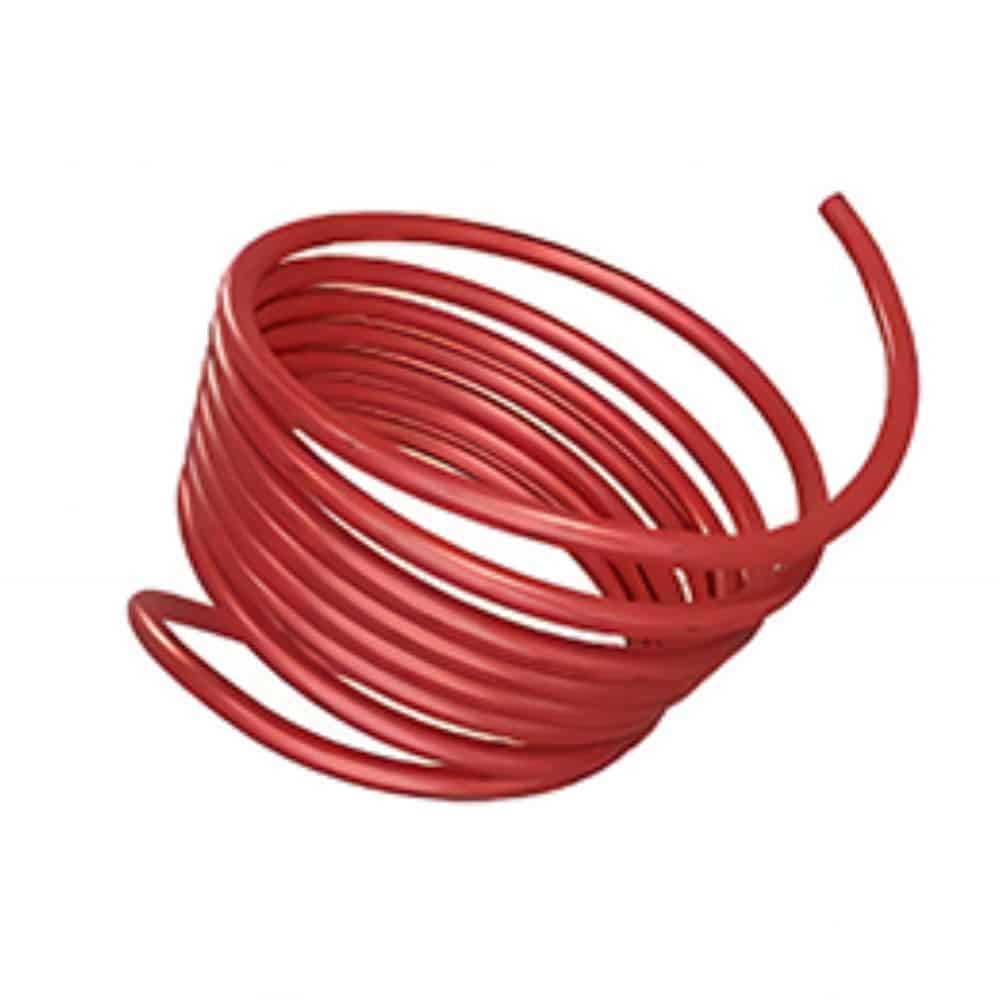
PE-RT 5-LAYER OXYGEN BARRIER-PIPE
Legom PE-RT 5-Layer Oxygen Barrier Pipe is a composite multi-layer pipe engineered for underfloor heating, hydronic HVAC, and domestic hot water systems where the highest level of oxygen protection and dimensional stability are required. Its five-layer construction integrates a dedicated EVOH (ethylene vinyl alcohol) oxygen barrier layer between inner and outer PE-RT layers, with adhesive bonding layers ensuring the composite structure performs as a single unified pipe wall throughout its service life.
With a Vicat softening temperature of 125°C, an oxygen permeability of ≤0.32 mg/m²d per DIN 4726, and a no-fracture impact rating at 23°C, the PE-RT 5-Layer pipe delivers the flexibility and heat resistance of PE-RT with an oxygen barrier performance that matches or exceeds dedicated barrier PEX pipes. The five-layer structure also produces one of the lowest thermal expansion coefficients in the Legom pipe range at 0.15E-4 m/m°K, reducing expansion-related stress in fixed screed installations.
Key Benefits
- Five-layer composite construction – Inner PE-RT layer, adhesive bonding layer, EVOH oxygen barrier layer, adhesive bonding layer, and outer PE-RT layer work together as a unified structure, combining the flexibility of PE-RT with the oxygen barrier performance of a dedicated barrier membrane
- Integrated EVOH oxygen barrier – The dedicated barrier layer provides oxygen permeability of ≤0.32 mg/m²d at 40°C per DIN 4726, protecting pumps, boiler heat exchangers, and manifold valves from oxygen-induced corrosion throughout the system’s service life
- Lowest thermal expansion in the Legom pipe range – Thermal expansion coefficient of 0.15E-4 m/m°K across 0°C to 70°C is lower than both PEX (0.13E-4 m/m°K) and PE-RTII (18E-4 m/m°K), reducing expansion-related stress in fixed screed and panel installations during thermal cycling
- No-fracture impact strength at 23°C – Passes ISO 179 impact testing at 23°C with no fracture, confirming toughness during installation and in service
- Vicat softening temperature of 125°C – Maintains shape and structural integrity well above normal underfloor heating operating temperatures, providing a wide safety margin
- Flexibility for easy installation – PE-RT outer layers retain the inherent flexibility of polyethylene, allowing the pipe to be bent and routed through floor heating loop patterns without becoming brittle or requiring additional fittings at curves
- High chemical purity and hygiene – Smooth inner PE-RT bore resists scale and biofilm accumulation, supporting clean water quality in both heating and potable water applications
- Eco-conscious construction – Multi-layer engineering optimizes material use and supports green building certification requirements
- OEM and ODM customization available – Pipe diameter, coil length, wall thickness, and labeling can be customized for distributor and system integrator requirements
Technical Specifications
| Product Parameter | Unit | Standard Value | Standard |
|---|---|---|---|
| Density | g/cm³ | 0.946 | ISO 1183 |
| Tensile yield stress [23°C] | MPa | 24 | ISO 527 |
| Tensile yield elongation [23°C] | % | 10 | ISO 527 |
| Elastic modulus | MPa | 850 | ISO 527 |
| Impact strength [23°C] | KJ/m² | No fracture | ISO 179 |
| Thermal expansion coefficient [0–70°C] | m/m°K | 0.15E-4 | DIN 53752 |
| Thermal conductivity [60°C] | W/m°K | 0.41 | DIN 52612 |
| Vicat softening temperature [A50] | °C | 125 | ISO 2507 |
| Oxygen permeability [40°C] | mg/m²d | ≤ 0.32 | DIN 4726 |
Application & Use Cases
- Underfloor heating systems – The primary application. The five-layer construction with integrated oxygen barrier is particularly well suited to screed-embedded installations where the pipe is in permanent contact with concrete and cannot be accessed for maintenance, making long-term oxygen barrier integrity critical
- Hydronic heating systems with ferrous metal components – Systems containing iron or steel components (older boilers, cast iron radiators, steel manifolds) benefit most from the pipe’s dedicated EVOH barrier layer, which significantly reduces oxygen ingress and the resulting corrosion and sludge formation
- Domestic hot water systems – The high chemical purity of the inner PE-RT bore supports clean potable water delivery, while the multi-layer structure provides mechanical durability in pressurized hot water circuits
- Radiant wall and ceiling heating – Used in radiant panel systems where the pipe is routed through wall or ceiling cavities and long-term dimensional stability during thermal cycling is a design requirement
- Heat pump and condensing boiler systems – The oxygen barrier protects sensitive heat pump heat exchangers and condensing boiler components from the accelerated corrosion that oxygen-permeable pipe can cause in low-temperature circuits
- Green building and sustainability-rated projects – The pipe’s eco-conscious multi-layer engineering and longevity support green building certification requirements where material durability and reduced replacement frequency are evaluated criteria
Installation Notes
- Store pipe coils in a cool, shaded location away from direct sunlight and heat sources before installation to prevent premature deformation of the composite layers
- Maintain the minimum bend radius specified for the pipe diameter. Kinking damages the EVOH barrier layer as well as the structural PE-RT layers, permanently compromising oxygen barrier performance
- Use only fittings compatible with multi-layer PE-RT pipe. The fitting must grip all five layers or be designed specifically for the pipe’s outer diameter and wall thickness. Do not use fittings designed for single-layer pipe only
- Use pipe staples, clips, or rail systems at recommended spacing intervals to hold the pipe in position before screed or concrete is poured in wet system installations
- Allow adequate expansion clearance at pipe penetrations through walls and floor edges. Despite the lower expansion coefficient, thermal movement still occurs over the full operating temperature range
- Protect pipe penetrations through concrete or screed with conduit sleeves to prevent abrasion at the entry point and allow for residual thermal movement
- Conduct a pressure test before screed or concrete is poured to verify all fittings and joints are leak-free. Test at 1.5 times working pressure for a minimum of 30 minutes
- Do not cut and re-join the pipe mid-loop without using rated fittings designed for the five-layer construction. Improper field joints compromise both pressure integrity and oxygen barrier continuity
Frequently Asked Questions
What does five-layer construction mean and why does it matter?
A five-layer pipe has a cross-section consisting of five distinct material layers bonded together: an inner PE-RT layer in contact with the fluid, a hot-melt adhesive bonding layer, a central EVOH oxygen barrier layer, a second hot-melt adhesive bonding layer, and an outer PE-RT layer. The adhesive layers are critical — they chemically bond the dissimilar PE-RT and EVOH materials into a single unified wall. Without strong adhesive bonding, the layers can delaminate under thermal cycling, destroying the oxygen barrier function. The five-layer construction combines the chemical resistance and flexibility of PE-RT with the gas barrier properties of EVOH in a way that a single-material pipe cannot achieve.
How does this pipe compare to single-layer PE-RT and PEX pipe with oxygen barrier?
Single-layer PE-RT pipe (without a barrier layer) relies on the inherent low oxygen permeability of the PE-RT material itself, which may not meet the ≤0.32 mg/m²d DIN 4726 requirement over the full service life at elevated temperatures. The PE-RT 5-Layer pipe’s dedicated EVOH barrier layer guarantees this limit is met independently of the PE-RT layer’s permeability. Compared to oxygen-barrier PEX, the PE-RT 5-Layer pipe offers the same oxygen protection with the additional advantage of greater flexibility due to the PE-RT outer layers, and in some configurations can be joined using heat-fusion methods not available for PEX. See also: PEX Type Pipe and PE-RTII Type Pipe.
Why is a low thermal expansion coefficient important for floor heating pipe?
When a heating system cycles between operating and standby temperatures, the pipe expands and contracts repeatedly. In screed-embedded installations, this movement is partially constrained by the surrounding concrete, creating internal stress in the pipe wall and at fittings. A lower expansion coefficient means less movement per degree of temperature change, reducing cumulative stress over thousands of heating cycles and contributing to longer service life and fitting integrity. At 0.15E-4 m/m°K, the PE-RT 5-Layer pipe expands less per metre than standard PE-RT single-layer pipe.
Can this pipe be used for potable water as well as heating?
The inner PE-RT layer in contact with the fluid provides high chemical purity and is suitable for potable water applications. The smooth inner bore resists scale and biofilm accumulation. Confirm local regulatory requirements for potable water pipe approvals in your market before specifying for drinking water use, as requirements vary by country and region.
What sizes and coil lengths are available?
Please contact the Legom team for current availability of pipe diameters, wall thicknesses, and coil lengths. OEM and ODM orders can be fulfilled with custom specifications including diameter, wall thickness, coil length, and print labeling.
OEM & ODM Customization
Legom supports full OEM and ODM services for the PE-RT 5-Layer Oxygen Barrier Pipe. Our manufacturing team can customize pipe diameter, wall thickness, coil length, surface printing, and packaging to match your product and brand requirements. All customization projects are handled with strict confidentiality. Contact us via WhatsApp or info@legomsmart.com.
Product information last reviewed by the Legom Technical Team. For the most current specifications, refer to the official datasheet or contact our sales team.
Related products


Custom OEM & ODM Solutions
Legom is a direct manufacturer offering end-to-end OEM and ODM services. With our in-house engineering and production capabilities, we work closely with distributors and system integrators to deliver fully customized solutions under strict NDA.
