

In the Heating, Ventilation, and Air Conditioning (HVAC) system, the role of valve design is crucial to ensure the flow of air, fluid, or gas is efficient and safe. Valves function as flow controllers and play an important role in maintaining the stability and performance of the HVAC system in the home. When building or renovating a house, consider the design used in the HVAC system.
Important Functions and Basic Principles of Valves in HVAC Systems
A valve is a mechanical component that controls fluid flow (both liquid and gas) in a system. In the HVAC system, valves regulate the distribution of coolant, hot water, and air throughout the house. Poor design can cause leaks, excessive pressure, or even system failure. Therefore, understanding the critical aspects of design is essential for HVAC system technicians and designers.
A suitable design must meet several fundamental principles. The first is flow efficiency. Valves must be appropriately designed to minimize flow resistance, which helps improve energy efficiency in HVAC systems. The design must withstand high pressures and temperatures according to the specifications of the HVAC system, providing security for homeowners.
Ensure the valve is airtight or liquid-tight. The valve must have a solid seal to prevent internal and external leakage. Another vital aspect of valve design is ease of maintenance. Valve components must be easy to disassemble for inspection or replacement without affecting the system’s overall performance. Using valves with a simple but efficient design is highly recommended because it minimizes the risk of damage and reduces operational costs.
Valve Design in HVAC
Good design requires understanding the type of valve suitable for specific needs in the HVAC system. Ball valves are designed to regulate flow using a rotating ball. Ball valves are ideal for home HVAC systems because they have a simple design, are easy to operate, and can withstand high pressure. Gate valves work by fully opening or closing the flow. This design is suitable for significant flow control in heating systems.
Butterfly valves are lightweight and compact, making them suitable for HVAC systems with limited space. This design also provides precise flow control. Another design is the solenoid valve, used in HVAC automation systems. This valve functions by utilizing electromagnetic fields to open or close the flow. The selection of the correct type of valve must be based on the specific needs of the HVAC system, such as pressure, temperature, and fluid flow.
Alongside these, thermostatic valves form their own category. Rather than being opened by a hand lever or an electrical signal alone, they respond directly to temperature, which makes them central to domestic hot water safety and to zone control in hydronic heating. The table below summarizes how the main types compare.
| Valve Type | Operating Principle | Best Suited To |
|---|---|---|
| Ball valve | Rotating ball opens or closes the bore | Isolation in domestic HVAC, high pressure |
| Gate valve | Gate rises or lowers across the flow | Full open or full close on large flows |
| Butterfly valve | Rotating disc within the pipe | Space-constrained installations |
| Solenoid valve | Electromagnetic coil actuates the seat | Automated on/off control |
| Thermostatic valve | Wax element expands with temperature | Hot water safety, zone temperature control |
Materials and Safety Standards in Valve Design for HVAC
The materials used in design significantly affect the reliability and durability of the valve. Common materials often used are brass, which has corrosion-resistant properties and is suitable for water flow at low to medium temperatures; stainless steel, ideal for HVAC systems requiring high-pressure resistance and extreme temperatures; and PVC or CPVC, which can be used for low-pressure flows and systems that do not require high temperatures.
The selection of materials must consider their compatibility with the fluid, environmental conditions, and durability for long-term use. Safety standards are also essential in material selection. Valves must be tested to withstand the maximum pressure in the HVAC system.
Another important aspect is temperature resistance. HVAC systems operate in extreme temperature ranges. Valve design must be able to withstand these temperatures without deformation or failure. Ensure the valves used meet product safety and quality standards. These standards provide quality assurance and protect homeowners from potential hazards due to system failure.
HVAC valve products are designed to ensure a safe and stable domestic hot water flow. Valves that feature thermostatic mixers allow for precise water temperature regulation, ensuring user comfort and safety. Use valve products that have international certifications, such as CE, WRAS, and RoHS, to guarantee their quality and reliability. Each of these covers something different: CE confirms compliance with European safety and electromagnetic directives, WRAS confirms that materials in contact with drinking water meet UK water regulations, and RoHS restricts hazardous substances in electronic components. For valves used with potable water in France and much of Europe, ACS certification serves a similar purpose to WRAS.
The Wax Element Behind Thermostatic Valve Design
In a thermostatic valve, the component that actually does the work is the wax thermostatic element. It contains a precisely formulated wax that expands as it warms and contracts as it cools, driving a piston that opens or closes the valve. The accuracy, response speed, and service life of the entire valve depend on the quality of this single component, which is why serious valve design begins here rather than with the body.
Legom manufactures its own wax thermostatic elements using a patented wax formula, with 36 models covering activation temperatures from -5°C to 135°C. Every element is individually tested and rated for 100,000 operating cycles, and the range carries ACS and WRAS certification for potable water applications. Because the element is produced in the same facility as the finished valves, the response characteristics of the valve can be tuned at the source rather than selected from whatever is available on the market.
Designing Good Valves for HVAC
Designing a valve that meets the needs of an HVAC system requires a thorough and structured approach. You must conduct a system analysis by understanding the HVAC system’s flow, pressure, and temperature requirements. Determine the material that is appropriate for the system’s operating environment. Conduct simulations to ensure the valve can handle the required flow capacity. Conduct prototype testing to ensure its efficiency and safety. A good design process focuses not only on function but also on practicality in installation and maintenance.
“Valve design is one of those fields where the visible part tells you almost nothing. Two thermostatic mixing valves can share the same brass body and the same connections, yet behave completely differently, because the difference sits inside in the wax element. That is where response time and long-term accuracy are decided. When we design a valve, the element specification comes first and the body is built around it. My advice to any specifier is to ask what the valve’s temperature accuracy is after tens of thousands of cycles, not just when it leaves the factory. That number tells you far more than the material list.”
— Maggie Shen, Director of Legom
Innovation Trends in Valve Design for HVAC
Valve design is also evolving to meet modern needs. The latest trend is the smart valve. This technology integrates the Internet of Things (IoT) to monitor and control flow through applications or sensors automatically. Alongside connectivity, two further trends are shaping current design: greater use of modular construction so that a single component can be replaced without removing the valve body, and a steady move toward proportional rather than on-off control, which allows flow to be modulated precisely instead of switched abruptly.
Introducing the 910064CC Electronic Thermostatic Mixing Smart Valve
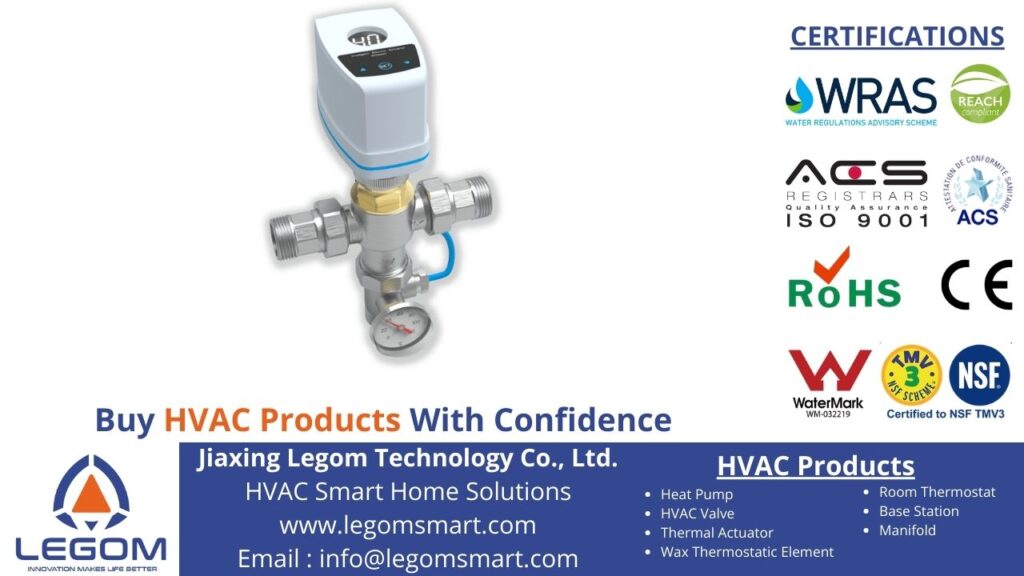
The 910064CC Electronic Thermostatic Mixing Valve is an excellent example of a smart valve designed to optimize the performance and safety of your HVAC system. Combining the reliability of a mechanical thermostatic mixing valve with the precision of an integrated electric actuator, this smart valve ensures consistent and accurate temperature control for your domestic hot water supply. Equipped with an intuitive LCD display, users can effortlessly monitor and adjust the outlet water temperature, while the optional networking feature enables remote temperature management through IoT-enabled applications.
The valve body is manufactured from high-quality brass, giving it corrosion resistance and durability in continuous hot water service. Safety features include anti-scalding protection, stable performance under pressure fluctuation, and liquid-tight seals to prevent leaks. The modular design allows for easy maintenance and component replacement, reducing operational costs and minimizing downtime. Certified to international standards including CE, WRAS, and RoHS, the 910064CC ensures reliability and peace of mind for homeowners.
| Specification | 910064CC |
|---|---|
| Valve body material | Brass |
| Voltage | DC 24V |
| Temperature accuracy | ±2.0°C |
| Hot water inlet temperature | 60°C to 65°C |
| Cold water inlet temperature | 10°C to 15°C |
| Maximum dynamic pressure | 5 bar |
| Minimum dynamic pressure | 0.5 bar |
| Certification | CE, WRAS, RoHS |
The 910064CC sits within a broader Legom HVAC valve range spanning 68 models across pressure valves and thermostatic valves, covering thermostatic mixing, temperature and pressure relief, freeze and scald protection, and circulation control. For zone control in hydronic heating, the same design philosophy applies to thermal actuators, which drive manifold valves using the same wax element principle. Consult with us for your HVAC valve inquiries.
Frequently Asked Questions
What makes a good HVAC valve design?
A good design balances five things: low flow resistance for energy efficiency, sufficient pressure and temperature rating for the system, a reliable seal against internal and external leakage, ease of maintenance so components can be replaced without disturbing the installation, and appropriate material selection for the fluid and environment. Simplicity matters too, since a design with fewer failure points is more reliable and cheaper to operate. Certification to recognized standards such as CE, WRAS, and RoHS confirms these requirements have been independently verified rather than merely claimed.
What is a smart valve and how does it differ from a conventional one?
A smart valve adds electronic monitoring and control to the mechanical function of a conventional valve. In practice this means an integrated actuator, a display or sensor feedback, and often network connectivity so the valve can be monitored and adjusted remotely through an application. The 910064CC is an example: it keeps the proven mechanical thermostatic cartridge but adds an electric actuator, an LCD display for the outlet temperature, and optional IoT networking. The mechanical reliability is retained while the user gains precision and remote visibility that a purely mechanical valve cannot provide.
Which material is best for an HVAC valve body?
It depends on the application. Brass is the most common choice for domestic hot water and heating because it resists corrosion well at low to medium temperatures and is straightforward to machine precisely. Stainless steel suits systems demanding higher pressure resistance and more extreme temperatures. PVC and CPVC are limited to low-pressure, lower-temperature circuits. The right choice comes from matching the material to the fluid, the operating temperature and pressure, and the expected service life rather than assuming one material is superior in all cases.
Why does the wax element matter so much in a thermostatic valve?
The wax element is what senses temperature and physically drives the valve, so it determines the valve’s accuracy, response speed, and how long that accuracy is maintained. Two valves with identical bodies can perform very differently depending on the element inside. A quality element holds its calibration across tens of thousands of operating cycles, while a poor one degrades and gradually loses accuracy, which in a mixing valve means the delivered water temperature drifts over time. When comparing thermostatic valves, ask about the element’s cycle rating and certification, not only the body material.
Reviewed by Maggie Shen, Director at Legom, on July 22, 2026. This article on HVAC valve design was reviewed for technical accuracy, including the material specification and certification details of the 910064CC.