
In recent years, people in Poland have begun to pay close attention to heat pumps, which generate energy from water, ground, or air and convert it into heat. The economic consequences of the Russia-Ukraine conflict have shifted the country’s energy priorities. As energy prices, particularly for gas and oil, surged in 2022, many Polish citizens sought more efficient, cost-effective alternatives with minimal environmental impact. Sustainability and energy efficiency quickly rose to the top of the list of considerations.
One of the major drivers of this shift was cost: while electricity prices also rose significantly across Europe, the running costs of heat pumps still favoured their adoption over traditional heating systems. The data below shows the scale of that growth, with 92,970 units installed in 2021, up from 56,470 in 2020 and 37,250 in 2019.
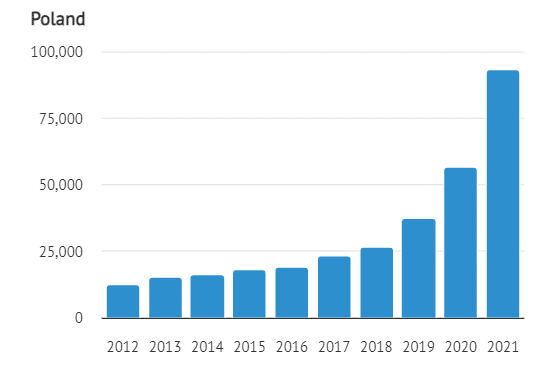
Annual heat pump installations in Poland. Source: Carbon Brief. Figures shown are for 2019 to 2021; the market has continued to develop since, with subsequent years affected by subsidy scheme changes and wider European market conditions.
Why Are Heat Pumps in Poland Suddenly at the Forefront?
For many years, Poland relied on coal for heating. However, due to global issues, the cost of coal has become prohibitive, especially during extreme weather conditions when many Polish households rely heavily on coal. In response, they explored alternatives, with heat pumps emerging as a solution offering two key advantages: sustainability and efficiency.
Although the cost of the device and installation is high, government subsidies and various programs have made this system more accessible. The government launched the Clean Air programme, known in Poland as Czyste Powietrze, with heat pumps as a key tool to achieve its goals. In just a year or two, a remarkable number of installations were completed, and many brands entered the Polish market to sell HVAC devices and components.
Poland also faces a distinct air quality problem that shapes this policy. Coal and solid fuel burning in domestic boilers produces particulate emissions, and several Polish cities have recorded among the poorest winter air quality in Europe. Replacing those boilers therefore serves two objectives at once, which is why the programme targets them specifically rather than heating in general.
A note for anyone planning around the subsidy. Programme rules, funding levels, and eligibility criteria are revised periodically, and equipment usually has to appear on an approved list to qualify. Check the current terms with the administering authority rather than relying on figures published in earlier years, since both the rates and the qualifying conditions have changed since the scheme began.
Challenges for Heat Pumps in Poland
With the surge in installations, the heat pump market has faced challenges. Companies need more staff to handle sales and installations. There have also been supply chain pressures, with manufacturers struggling to keep up with demand. Despite these obstacles, the government remains committed to transitioning from coal to more sustainable energy sources.
Two further challenges are worth naming, because they affect whether installations perform as intended.
Installer capacity and quality. Rapid market growth outpaces the training of qualified installers, and a heat pump installed without a proper heat loss calculation or correct commissioning delivers a fraction of its potential efficiency. Owners then conclude the technology underperforms when the specification was at fault.
Building stock and emitters. Many Polish homes were built with high-temperature radiator systems sized for coal or gas boilers. A heat pump connected to radiators expecting 70 to 80°C water operates in its least efficient range, which is why emitter assessment matters as much as equipment selection in this market. We return to this below.
Poland has a broader plan to generate energy from renewable sources, including nuclear. The country aims to achieve greater energy independence over the coming decades, and its commitment is evident in continuous efforts to upgrade technology. The government is not focused solely on one type of sustainable energy but supports other green initiatives as well, remaining open to new innovations with the goal of reducing reliance on fossil fuels.
Furnaces vs Heat Pumps in Poland
Furnaces have traditionally been popular for heating homes, leading to some confusion when choosing between them and heat pumps. This decision has become even more significant due to increasingly extreme weather conditions. While both devices provide heat, they operate differently.
Cost
The cost of installation is a key factor. Heat pumps have a higher installation cost but lower operational expenses. Furnaces are cheaper to install but more expensive to run over time. Subsidy availability changes this arithmetic substantially, which is why the current programme terms matter to the decision.
Safety
Furnaces involve combustion, which carries risks that an electric heat pump does not: carbon monoxide, fuel storage where applicable, and the need for a flue and annual safety inspection. Modern furnaces include safety features to mitigate these risks, but the risks exist to be mitigated. A heat pump removes the combustion entirely.
Functionality
Heat pumps transfer heat from one place to another, providing both heating and cooling from a single unit. Furnaces burn fuel to generate heat and provide heating only, so homes with furnaces typically require separate cooling equipment.
On the frequently repeated claim that heat pumps suit mild climates and furnaces suit cold ones, this deserves updating. It was accurate for older equipment. Current cold-climate heat pumps maintain useful output well below freezing, which is precisely why adoption has grown in Poland, Scandinavia, and other cold markets rather than only in temperate ones.
Hybrid systems
Rather than choosing between them, the two can work together. In a hybrid arrangement the heat pump covers most of the heating season efficiently while the boiler or furnace handles the coldest days when heat pump output falls. This allows the heat pump to be sized for typical rather than peak demand, reducing its cost, and it suits retrofit projects in older housing where replacing all the emitters is impractical.
The trade-off is that a fuel-burning appliance stays in the building. In a market pursuing air quality improvement through coal replacement, that is worth weighing, and hybrids are generally best regarded as a transitional step.
What Determines Whether a Heat Pump Performs in Polish Housing
This is the practical question behind the policy, and it is where installations succeed or disappoint.
Every emitter requires water at a particular temperature to deliver its rated output. Radiators sized for a coal or gas boiler expect 70 to 80°C. Underfloor heating needs only 30 to 45°C. A heat pump becomes markedly more efficient the lower the flow temperature it must produce.
The difference is substantial rather than marginal. A unit producing 35°C water achieves a COP around 4.5. The same unit producing 45°C achieves around 3.6, roughly 25% less heat from the same electricity. Connected to radiators demanding 75°C, the shortfall is greater still.
Three routes resolve this in an existing building. Replace the emitters with underfloor heating. Oversize the radiators so they deliver the same output at 45 to 55°C. Or improve insulation so demand falls and lower flow temperatures suffice. In Poland’s older housing stock, a combination of insulation improvement and radiator oversizing is frequently the most economical, and it is worth addressing before the equipment is chosen rather than afterwards.
Cold Climate Performance

Polish winters are demanding, and cold-weather capability is a genuine specification question rather than a marketing point.
Legom air source heat pumps are engineered to keep operating at ambient temperatures down to -35°C, which covers Polish winter conditions across the country including the colder north-east. Two design elements make this possible: a full DC inverter compressor that raises its speed to compensate as available heat in the outdoor air falls, and demand-based defrosting that clears frost from the air-side heat exchanger only when frost is actually detected, avoiding the frequent ineffective cycles that undermine cold-weather comfort in simpler designs.
Output does decline as ambient temperature drops, which is unavoidable physics for any air source heat pump rather than a product weakness. Cold-climate projects should therefore be sized against the local design temperature rather than the nominal rating, and being clear about this is more useful to an installer than an optimistic figure.
For context on Polish winter conditions, see our article on how cold Poland gets and the pollution issue.
The Legom Range for the Polish Market
Legom manufactures air-to-water monoblock heat pumps in four capacities at its facility in Jiaxing, Zhejiang Province, and exports to distribution partners in Poland among other markets.
| Parameter | 5 kW | 6 kW | 9 kW | 16 kW |
|---|---|---|---|---|
| Heating range | 2.0–6.0 kW | 3.0–8.0 kW | 3.5–10.0 kW | 6.5–18.0 kW |
| COP at A7/W35 | 4.5 | 4.42 | 4.46 | 4.53 |
| Hot water capacity | 6 kW | 8 kW | 10 kW | 18 kW |
| ERP at 35°C | A+++ | A+++ | A+++ | A+++ |
| Minimum ambient | -35°C | -35°C | -35°C | -35°C |
All models use R32 refrigerant with full DC inverter compressors, provide reversible heating and cooling, and carry CE and RoHS certification. Because Legom also manufactures the manifolds, floor heating pipe, thermal actuators, and room thermostats that complete a hydronic system, distributors can source the full installation from one manufacturer with compatibility designed in.
For partners supplying under their own brand, OEM and ODM services cover cabinet colour, branding, packaging, and controller configuration. Where subsidy eligibility requires equipment to appear on an approved list, that is worth confirming as part of the specification discussion.
“Poland has been one of the fastest-moving heat pump markets in Europe, and the reason is straightforward: households were paying a great deal for coal and gas, and the air quality problem gave the policy a second justification. What I would say to distributors there is that the technical question is not whether a heat pump works in a Polish winter. Ours run to minus thirty-five, and that covers the country. The question is what the radiators in the house were sized for. Connect a heat pump to emitters designed around a coal boiler and it will work while costing far more to run than expected. That conversation is worth having before the sale, not after.”
— Maggie Shen, Director of Legom
Heat Pumps in Poland for an Independent and Sustainable Future
To support Poland’s clean energy goals and enhance the country’s HVAC systems, Legom supplies components designed for efficiency and built for cold-climate operation. As a manufacturer working with distribution partners rather than end users directly, our role is to ensure the performance and longevity of the systems those partners install.
With government commitment to sustainability continuing, and with air quality providing a second reason to replace solid fuel boilers, the direction of the Polish market is clear. What determines whether individual installations deliver on that promise is specification: correct sizing against a calculated heat load, emitters that allow low flow temperatures, and proper commissioning afterwards.
Contact the Legom team to discuss supply, specification, or partnership for the Polish market.
Frequently Asked Questions
Why are heat pumps growing so fast in Poland?
Three factors combined. Energy prices for gas and oil surged in 2022 following the Russia-Ukraine conflict, making running costs a priority. Poland’s historic reliance on coal for domestic heating created a serious winter air quality problem, giving the transition a second justification beyond cost. And the government’s Clean Air programme provided subsidies that offset the higher installation cost. Installations rose from 37,250 in 2019 to 92,970 in 2021, and the market has continued developing since.
Do heat pumps work in Polish winters?
Yes. Modern cold-climate units maintain useful output well below freezing, and Legom heat pumps are engineered to operate at ambient temperatures down to -35°C, which covers Polish winter conditions across the country. Output does decline as temperature falls, which applies to every air source heat pump and is unavoidable physics rather than a product weakness, so projects should be sized against the local design temperature rather than the nominal rating.
What is the Clean Air programme?
Known in Poland as Czyste Powietrze, it is a government scheme providing financial support for replacing inefficient solid fuel heating with cleaner alternatives, including heat pumps, alongside building insulation improvements. It addresses both energy costs and the winter air quality problem caused by domestic coal burning. Programme rules, funding levels, and eligibility are revised periodically, and equipment usually needs to appear on an approved list, so check current terms with the administering authority.
Should I choose a heat pump or a furnace in Poland?
A heat pump costs more to install and less to run, provides cooling as well as heating, and involves no combustion, flue, or fuel storage. A furnace costs less upfront and more over time, and heats only. The claim that heat pumps suit mild climates and furnaces suit cold ones was accurate for older equipment but is outdated: current cold-climate units maintain output well below freezing. Subsidy availability changes the arithmetic considerably, so check current programme terms.
Can I use a heat pump with my existing radiators?
Physically yes, but with an important caveat that matters especially in Polish housing. Radiators sized for a coal or gas boiler expect 70 to 80°C water, and asking a heat pump to produce that pushes it into its least efficient range, so the system works while costing far more to run than expected. Oversizing the radiators so they deliver the same output at 45 to 55°C recovers most of the efficiency, and improving insulation reduces the demand further. Assess this before choosing the equipment.
What is a hybrid heat pump system?
An arrangement pairing a heat pump with a boiler or furnace, switching between them according to conditions. The heat pump covers most of the season efficiently while the fuel-burning appliance handles the coldest days, which allows the heat pump to be sized for typical rather than peak demand and reduces its cost. It suits retrofit projects in older housing where replacing all emitters is impractical. The trade-off is that a combustion appliance remains, which matters in a market pursuing air quality improvement.
What size heat pump is needed for a Polish home?
It depends on the calculated heat loss rather than floor area, since insulation standard, glazing, and orientation all change the answer. Note that minimum modulated output matters as much as maximum: a unit that cannot throttle below 6.5 kW will cycle badly in a house whose mild-weather demand is 3 kW, and mild weather makes up most of the heating season. Oversizing is a real error rather than a safe margin, so a proper heat loss calculation is worth insisting on.
Does Legom supply distributors in Poland?
Yes. Legom exports air-to-water heat pumps to distribution partners in Poland and manufactures the complete hydronic system at the same facility, including manifolds, floor heating pipe, thermal actuators, and room thermostats, so a full installation can be sourced from one manufacturer. OEM and ODM services are available for partners supplying under their own brand, covering cabinet colour, branding, packaging, and controller configuration.
Reviewed by Maggie Shen, Director at Legom, on August 25, 2026. This article on the Polish heat pump market was reviewed for accuracy, including verified cold-climate operating limits and the relationship between existing emitter temperatures and achievable efficiency.