
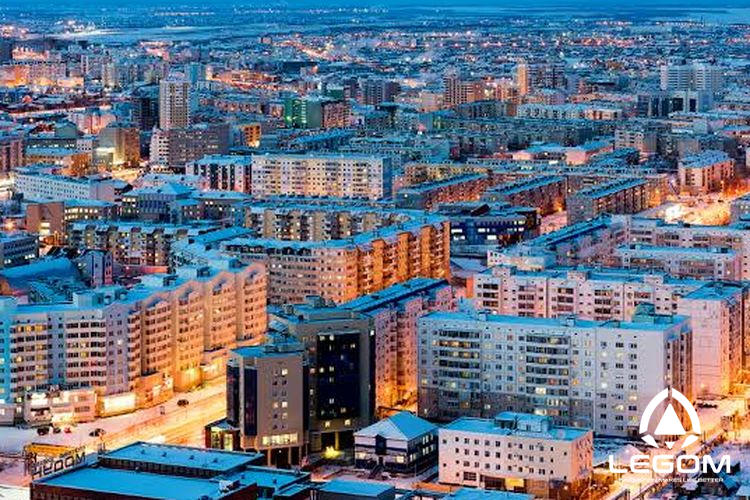
Yakutsk, the capital of the Sakha Republic in Russia, is widely recognized as the coldest city in the world. While the term “coldest place” may refer to uninhabited regions or research stations, a city is defined as a permanently inhabited area with established infrastructure and residents. In this context, Yakutsk stands out as the coldest city on Earth where people live year-round.
For those who come from countries with four seasons, winter already represents the coldest period of the year. However, winter conditions in Yakutsk go far beyond typical cold weather. Temperatures regularly fall below −40°C, making daily life a constant challenge that requires adaptation, resilience, and advanced infrastructure.
Contents
Yakutsk Average Temperatures Throughout the Year (2025)
The table below shows typical average temperatures in Yakutsk throughout the year, highlighting the extreme seasonal contrasts experienced by residents.
| Month | Season | Average Temperature |
|---|---|---|
| January | Winter | −38°C to −42°C |
| February | Winter | −35°C to −40°C |
| March | Late Winter | −25°C to −30°C |
| April | Spring | −10°C to −5°C |
| May | Spring | 5°C to 10°C |
| June | Summer | 15°C to 20°C |
| July | Summer | 18°C to 22°C |
| August | Summer | 12°C to 18°C |
| September | Autumn | 2°C to 7°C |
| October | Autumn | −10°C to −15°C |
| November | Early Winter | −25°C to −30°C |
| December | Winter | −35°C to −40°C |
Note: Temperatures shown represent typical observed ranges. Actual daily temperatures may vary significantly due to extreme continental climate conditions.
Living in the Coldest City in the World
Living in a place with special conditions is also challenging and remarkable. Summer and winter are two extreme seasons already. But in the lowest-temperature city, the sensation is far different.
To live, the human body has to adapt to the environment. The experts and the scientists work hard to create devices to make people comfortable and easier to adapt. Changing the weather and climate is impossible but creating a building with convenient temperature is still possible.
There are some cities as the candidate to win the lowest temperature category. However, Sakha Republic has a city with constant low temperatures with four to five hours of sunlight per day in January. It’s the capital city, Yakutsk, located on the Lena River, was first built as a wooden fort.
Founded in 1632 as a wooden fort, Yakutsk has grown into a modern city with a population of approximately 372,801 people as of 2025. Much of the local economy is supported by the diamond mining industry, and the city’s architecture reflects its unique environment. Wooden houses, apartment blocks, and high-rise buildings coexist, all designed to withstand severe cold.
Those buildings are built above permafrost with steady and frozen soil that never seems to melt. Buildings usually produce heat from electric devices and the heating system. However, it’s not enough to melt the ice, and the inhabitants have to be aware of the cold.
Building on Permafrost
All buildings in Yakutsk are constructed on permafrost, a permanently frozen layer of soil that never fully melts. Structures are elevated above the ground to prevent heat from buildings from thawing the ice, which could destabilize foundations.
Despite the heat generated by electrical devices and heating systems, the ground remains frozen. As a result, residents must constantly remain aware of the extreme cold and the importance of reliable infrastructure.
The Heating System in Yakutsk
The first line of defense against the cold is clothing. From head to toe, people wear fur hats, fur boots, and fur coats. For the ears, they often don’t need earmuffs because the fur hats provide wide coverage. However, proper clothing must be supported by an effective heating system.
Unlike tropical countries where heating systems are not a primary concern, in this city, they are as important as any staple. Heating is extremely vital here. In rural areas, people use wood-burning stoves to maintain a comfortable temperature, lighting the wood two to three times a day. They place brick heating stoves in the center of the house to distribute the heat evenly.
Throughout the city, people rely on coal heating systems. Many administrative buildings depend on coal heating. They place the pipes of the heating system above the ground. In harsh winter, operators must check and maintain the heat more diligently. During these hard times, operators work in shifts without respite. If they miss maintaining the heat even once, someone in the city might be in danger.
Outsiders often wonder about the coal supply that powers the system. The answer is quite fascinating. There is no need to worry about coal because this area has high-quality coal with abundant supply. It has run well for many years to warm the entire city. However, alongside traditional coal heating, modern heating solutions have been integrated to enhance efficiency and environmental sustainability. One such solution is the use of R32 heat pumps, which are highly efficient even in extremely cold conditions. These heat pumps use a more eco-friendly refrigerant, providing a reliable and sustainable source of heat.
To sum up, living in the coldest city in the world might sound tough, but as long as the heating system runs well, it will be okay. The combination of traditional methods and modern technologies, like R32 heat pumps, ensures that the citizens of Yakutsk remain healthy and happy despite the extreme cold.
Last updated: 21 January 2026