

An air to water heat pump extracts heat from the outside air and transfers it into water, which then circulates through underfloor heating, radiators, or a domestic hot water cylinder. It is a subcategory of air source heat pump, and it is the type used almost universally in European wet heating systems.
We have explained air source heat pumps in many of our articles before, as they are one of our main products and areas of expertise. This guide covers the air-to-water category specifically: how it works, what it connects to, what determines its efficiency, the different configurations available, and how to choose the right one.
What an Air to Water Heat Pump Actually Is
The name describes two things at once, and separating them makes the category clear.
Air refers to where the heat comes from. The unit draws thermal energy out of outdoor air, even in cold weather, because air above absolute zero contains extractable heat.
Water refers to where that heat goes. Rather than blowing warm air into a room, the unit transfers heat into a water circuit that runs through the building.
This distinguishes it from an air-to-air heat pump, which delivers heat directly into indoor air through a wall-mounted unit in the manner of a reversible split air conditioner. The two are not interchangeable products: a building with wet heating needs air-to-water, while one with ducts or no distribution at all may suit air-to-air. Our article on heat pump versus air conditioner covers that distinction in full.
Air-to-water units are also the only type that can supply domestic hot water, because they produce hot water rather than hot air. For most European households this is decisive, since space heating and hot water together account for the great majority of home energy use.
How an Air to Water Heat Pump Works
The mechanism is a refrigeration cycle running in reverse, and understanding it explains why the efficiency figures exceed 100%.
Evaporation. Refrigerant at very low temperature and pressure passes through the air-side heat exchanger. Outdoor air is blown across it, and because the refrigerant is colder than the air, heat flows into it and the refrigerant evaporates into gas. This works even at sub-zero ambient temperatures because the refrigerant is colder still.
Compression. The compressor raises the pressure of that gas, and pressure and temperature rise together. The heat collected across a large volume of cool air is now concentrated into a small volume of hot gas. This is the only stage that consumes significant electricity.
Condensation. The hot gas passes through a plate heat exchanger where it meets water from the heating circuit. Heat transfers into the water, the refrigerant condenses back to liquid, and the warmed water is pumped into the building.
Expansion. An electronic expansion valve drops the pressure sharply, the refrigerant cools, and the cycle begins again.
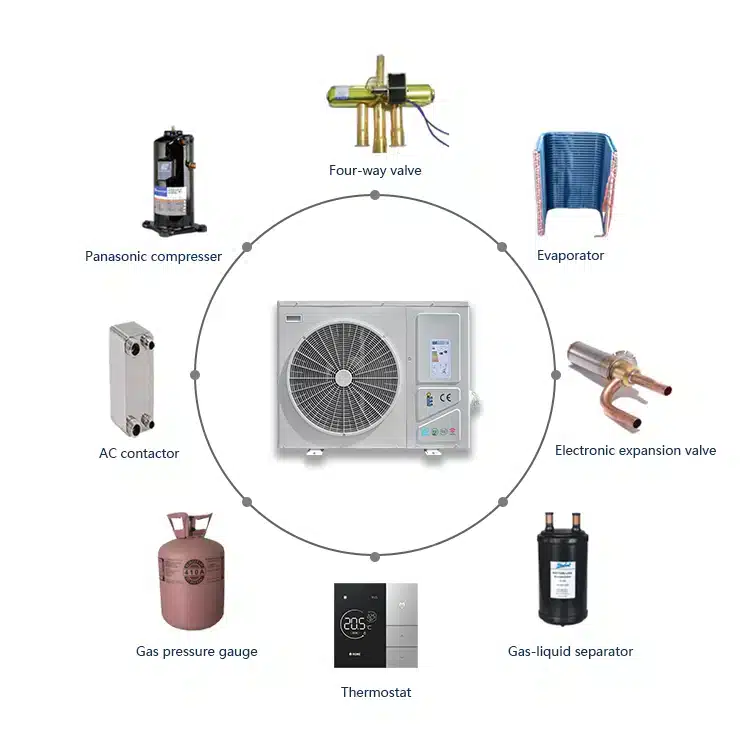
The critical point is that no heat is created. The unit transports heat that already exists in outdoor air, and electricity is spent on moving it rather than generating it. That is why a heat pump delivers three to four units of heat per unit of electricity, while a system that generates heat from electricity directly is limited to one for one.
What It Connects To: Emitters and Distribution
Because an air-to-water unit produces hot water, everything downstream of it is a wet system, and the choice of emitter is more consequential than most buyers realise.
Underfloor heating
The natural partner, and the pairing that produces the best efficiency. Underfloor heating performs comfortably at 30 to 45°C flow temperature because it emits from the entire floor area rather than a small panel. Warm water reaches a manifold that distributes it between individual floor heating pipe loops, each controlled by a thermal actuator responding to its own room thermostat.

Radiators
Air-to-water units can feed radiators, and this is common in retrofit projects. The caveat is that radiators sized for a gas boiler expect 70 to 80°C water, which pushes the heat pump into its least efficient operating range. Oversizing the radiators so they deliver the same output at 45 to 55°C preserves most of the efficiency benefit, and is considerably less disruptive than installing underfloor heating throughout.
Fan coil units
A fan coil takes hot or chilled water from the heat pump and blows air across the coil into the room. This combines water distribution with fast response, and importantly it allows the same system to deliver cooling in summer without the condensation concerns that radiant cooling raises.
Domestic hot water cylinder
A cylinder heated by the heat pump supplies showers, taps, and appliances. Hot water requires higher temperatures than space heating, typically 50 to 60°C for storage, so the unit runs at lower efficiency during hot water production than during space heating. This is normal and expected rather than a fault.
Flow Temperature: The Variable That Determines Everything
If you take one technical point from this guide, take this one. The temperature of the water an air-to-water heat pump must produce determines its efficiency more than any other factor, and the effect is large rather than marginal.
The figures from the Legom range illustrate it concretely, measured at the same outdoor condition of 7°C:
| Model | COP at 35°C flow | COP at 45°C flow | Difference |
|---|---|---|---|
| 5 kW | 4.5 | 3.6 | 25% more heat at 35°C |
| 6 kW | 4.42 | 3.43 | 29% more heat at 35°C |
| 9 kW | 4.46 | 3.45 | 29% more heat at 35°C |
| 16 kW | 4.53 | 3.65 | 24% more heat at 35°C |
These are identical machines in identical outdoor conditions. The only variable is the water temperature they are asked to produce, and it changes the output per unit of electricity by roughly a quarter to nearly a third.
The practical consequence. Installing an air-to-water heat pump into a system whose radiators demand 75°C water means it will never achieve the efficiency quoted on its datasheet. The equipment is not at fault, and neither are the radiators. The mismatch is. Establish what flow temperature your emitters require before selecting the heat source, and if the answer is high, plan to address it through oversized radiators, underfloor heating, or improved insulation.
Types of Air to Water Heat Pumps
There are several configurations based on function and design, and the right one depends on your building rather than on which sounds most advanced.
| Type | Structure | Installation | Best suited to |
|---|---|---|---|
| Monoblock | All components in one outdoor unit | Simplest, no indoor refrigerant work | Most homes, straightforward installs |
| Split | Outdoor and indoor units linked by refrigerant lines | Requires certified refrigerant handling | Homes with utility space, freeze-risk areas |
| With integrated cylinder | Heat pump plus hot water tank as one package | Moderate, fewer separate components | Homes needing heating and hot water together |
| Inverter-controlled | Variable-speed compressor, applies to any of the above | Same as base type | Almost all modern installations |
| Hybrid | Heat pump paired with a boiler | Most complex, needs switching control | Retrofit where emitters cannot be changed |
Monoblock air-to-water heat pump
In a monoblock system, the entire heat pump is outside the building. All components including the compressor, evaporator, and condenser sit in one unit, and only water pipes enter the building.
The advantage is ease of installation, because no refrigerant pipework runs indoors and therefore no refrigerant handling certification is needed on the indoor side. The design is compact, which suits residential and small commercial applications. The consideration in very cold climates is that the water circuit runs outdoors within the unit, so freeze protection matters, which quality units address through built-in protection and antifreeze provision.
Split air-to-water heat pump
This system consists of an outdoor unit housing the evaporator and compressor, and an indoor unit housing the heat exchanger and water pump, connected by refrigerant lines.
Placing the water-side components indoors removes any freeze risk on the water circuit, and the indoor unit can go in a basement or utility room. The trade-off is that refrigerant pipework must be installed and charged by a certified technician, since handling fluorinated refrigerants is legally restricted in most jurisdictions.
Air-to-water heat pump with hot water cylinder
This packages the heat pump with an integrated or closely coupled hot water storage tank, providing both space heating and domestic hot water from one system. Some versions are designed to reach the higher water temperatures that radiator systems and hot water storage require.
The practical benefit is fewer components to specify and fewer connections to make and later inspect, which matters where plant space is tight.
Inverter-controlled air-to-water heat pump
Inverter technology varies the compressor speed to match actual demand rather than switching fully on and off. This deserves more emphasis than it usually receives, because it affects both efficiency and equipment life.
A fixed-speed unit produces full output or nothing, so on a mild day it reaches the set point, shuts off, then restarts repeatedly. Every start places mechanical and electrical stress on the compressor. An inverter unit throttles down and runs steadily instead, which improves seasonal efficiency and reduces wear. Legom units modulate steplessly from 20% to 120% of nominal output.
Hybrid air-to-water heat pump
Hybrid systems combine an air-to-water heat pump with another heat source such as a gas boiler, switching between them based on outdoor temperature and demand.
The advantage is reliable heating on the coldest days while allowing the heat pump to be sized for typical rather than peak demand, which reduces its cost. The honest caveat is that a fossil fuel appliance stays in the building with its flue, fuel connection, and maintenance, which in markets phasing out gas heating makes it a transitional rather than permanent arrangement.
Sizing an Air to Water Heat Pump
Capacity should be matched to the building’s calculated heat load rather than its floor area, and both sizing errors carry consequences.
An undersized unit runs continuously and still fails to reach temperature on the coldest days. An oversized unit reaches the set point quickly then shuts down, cycling repeatedly rather than modulating steadily, which delivers worse comfort and wears the compressor faster.
The figure that catches people out is the minimum modulated output rather than the maximum. A unit that cannot throttle below 6.5 kW will cycle badly in a house whose mild-weather demand is 3 kW, and mild weather makes up most of the heating season. Oversizing is therefore a real error rather than a safe margin.
| Capacity | Modulation range | Typically suits |
|---|---|---|
| 5 kW | 2.0–6.0 kW | Small to medium homes, 2–3 bedrooms |
| 6 kW | 3.0–8.0 kW | Medium homes, higher hot water demand |
| 9 kW | 3.5–10.0 kW | Medium to large homes, older properties |
| 16 kW | 6.5–18.0 kW | Large homes, light commercial buildings |
A qualified installer should perform a heat loss calculation before capacity is confirmed. Floor area alone ignores insulation, glazing, ceiling height, orientation, and hot water demand, all of which change the answer substantially.
Domestic Hot Water Performance
This is where air-to-water units differ most clearly from air-to-air, and it deserves its own consideration because hot water demand is often what determines the capacity chosen rather than space heating.
| Capacity | DHW heating capacity | Water yield | COP |
|---|---|---|---|
| 5 kW | 6 kW | 129 L/h | 4.4 |
| 6 kW | 8 kW | 172 L/h | 4.3 |
| 9 kW | 10 kW | 215 L/h | 4.32 |
| 16 kW | 18 kW | 387 L/h | 4.35 |
A household with two bathrooms in simultaneous morning use will notice the difference between 129 and 215 litres per hour far more than it notices a small difference in space heating capacity. Actual delivery also depends on cylinder size, incoming cold water temperature, and target storage temperature, so confirm the whole hot water arrangement rather than the heat pump alone.
Cold Climate Performance
Many people assume air to water heat pumps cannot handle temperatures well below average. That is true for some older or low-specification units which struggle in extremely cold weather, but modern models are engineered for efficient operation in sub-zero climates.
Legom heat pumps are designed to keep operating at ambient temperatures down to -35°C, with COP figures ranging from 4.42 to 4.53 at standard test conditions across the range. This covers the great majority of populated cold regions, including Northern and Eastern Europe, and Legom exports to distribution partners in Poland and Russia among other markets.
Two design elements make this possible. The inverter compressor raises its speed to compensate as the heat available in outdoor air falls, sustaining output where a fixed-speed unit cannot. And demand-based defrosting clears frost from the air-side heat exchanger only when frost is actually detected, avoiding the frequent ineffective cycles that undermine cold-weather comfort in simpler designs.
Output does decline as ambient temperature drops, which is unavoidable physics for any air source unit rather than a product weakness. Cold-climate projects should therefore be sized against the local design temperature rather than the nominal rating.
Installation Requirements
Outdoor clearance. The unit needs unobstructed airflow on all sides to absorb heat effectively. Restricting it reduces both output and efficiency, and this is a common cause of underperformance in otherwise correct installations.
Noise and siting. The fan and compressor produce sound. Legom units range from 52 to 56 dB(A) depending on capacity, but placement matters more than the rating: avoid positions directly beneath bedroom windows and corners where sound reflects off two surfaces.
Water connections. Confirm the port size against your pipework. Smaller units typically use G3/4 DN20 while larger ones step up to G1.0 DN25, reflecting the higher flow rate they circulate. Reducing the connection at the unit introduces a restriction exactly where flow matters most.
Expansion vessel. Check whether one is included. Some larger units incorporate an expansion tank while smaller ones require one to be specified separately as part of the system design.
Electrical supply. Larger units draw substantially more current and may require or benefit from three-phase supply. Verify available capacity before committing to a capacity, particularly on commercial projects.
Costs and Running Costs
The upfront cost of an air-to-water heat pump exceeds that of a gas boiler, and how much more depends heavily on what the building already has. A property with existing wet pipework and suitable emitters costs far less to convert than one requiring new distribution throughout.
Running cost is where the case is made, and it turns on a comparison rather than an absolute. Against direct electric heating the advantage is decisive, since a heat pump delivers three to four times the heat per unit of electricity. Against oil it usually wins. Against gas the outcome depends on the local ratio between electricity and gas prices, which is why the same equipment can be cheaper to run than a boiler in one country and more expensive in another.
Government incentives change the arithmetic materially in many markets, and these vary by country and are revised periodically, so check current schemes for your region before assessing payback.
Sustainability
The environmental case rests on two things beyond efficiency itself.
No combustion at the point of use. The unit produces no nitrogen oxides or particulates at the property, which improves local air quality as well as reducing carbon.
Decarbonising with the grid. A heat pump runs on electricity, so its emissions fall automatically as the electricity supply decarbonises. A gas boiler installed today will emit the same in fifteen years; a heat pump will emit progressively less without any intervention from the owner.
Refrigerant matters too. Legom units use R32, with a Global Warming Potential of 675 against 2088 for the older R410A it replaces, and requiring a smaller charge for the same output. Under the European F-Gas Regulation and equivalent rules elsewhere, high-GWP refrigerants face progressive restriction, which makes equipment charged with them harder and more expensive to service over time.
“The question I am asked most often about air-to-water is whether it will be efficient enough, and the honest answer is that it depends on something the buyer usually has not considered. Our units achieve a COP around 4.5 at thirty-five degree flow temperature. The same units achieve about 3.6 at forty-five. Nothing about the machine changed. What changed is what it was asked to produce. So when someone tells me their heat pump underperformed, my first question is never about the heat pump. It is what temperature their emitters need. Get that answered before you choose the equipment and the rest of the specification is straightforward.”
— Maggie Shen, Director of Legom
The Legom Air to Water Heat Pump Range

Legom manufactures air-to-water monoblock heat pumps in four capacities at its own facility in Jiaxing, Zhejiang Province, supplied to partners in more than 90 countries.
| Parameter | 5 kW | 6 kW | 9 kW | 16 kW |
|---|---|---|---|---|
| Heating range | 2.0–6.0 kW | 3.0–8.0 kW | 3.5–10.0 kW | 6.5–18.0 kW |
| COP at A7/W35 | 4.5 | 4.42 | 4.46 | 4.53 |
| Cooling capacity | 4 kW | 5 kW | 6.5 kW | 14 kW |
| Hot water | 6 kW | 8 kW | 10 kW | 18 kW |
| ERP at 35°C | A+++ | A+++ | A+++ | A+++ |
| Noise | ≤52 dB(A) | ≤54 dB(A) | ≤55 dB(A) | ≤56 dB(A) |
| Water port | G3/4 DN20 | G3/4 DN20 | G1.0 DN25 | G1.0 DN25 |
All models use R32 refrigerant with full DC inverter twin rotary compressors, provide reversible heating and cooling, operate down to -35°C, and carry CE and RoHS certification. Because Legom also manufactures the manifolds, floor heating pipe, thermal actuators, room thermostats, and HVAC valves that complete a hydronic system, a full installation can be sourced from a single manufacturer with compatibility designed in rather than assumed. OEM and ODM services are available across the range.
Conclusion
An air to water heat pump is an efficient and sustainable option for heating and hot water production, offering both environmental benefits and cost savings when specified and installed correctly. It works with radiant floor heating, radiators, and fan coils for space heating, supplies household hot water for showers, sinks, and appliances, and extends to swimming pool heating and commercial applications in schools, offices, hospitals, and hotels.
The decision that most affects whether it performs as promised is not which unit you buy but what temperature your emitters require. Answer that first, size against a proper heat loss calculation rather than floor area, and the technology delivers what its specification suggests.
Frequently Asked Questions
What is an air to water heat pump?
It is a heat pump that extracts heat from outdoor air and transfers it into water, which then circulates through underfloor heating, radiators, fan coils, or a domestic hot water cylinder. It is a subcategory of air source heat pump, distinguished from air-to-air units which deliver heat directly into indoor air. Because it produces hot water rather than hot air, it is the only type that can supply domestic hot water as well as space heating, which is why it dominates European wet heating installations.
How efficient is an air to water heat pump?
Modern units achieve a COP between roughly 4.4 and 4.5 at standard test conditions of 7°C outdoor air producing 35°C water, meaning four to four and a half units of heat per unit of electricity. However, the efficiency you achieve in service depends heavily on the water temperature required. The same unit producing 45°C water instead of 35°C drops to around 3.4 to 3.6, roughly a quarter to a third less heat for the same electricity. Emitter choice therefore affects real-world efficiency more than the choice of unit does.
What is the difference between air to air and air to water?
Where the heat is delivered. Air-to-air units transfer heat directly into indoor air through a wall or ceiling unit, which is what a reversible split air conditioner does. Air-to-water units transfer heat into a water circuit that feeds underfloor heating, radiators, or a hot water cylinder. They are not interchangeable: buildings with wet heating need air-to-water, while those with ducts or no distribution may suit air-to-air. Only air-to-water can supply domestic hot water.
Can an air to water heat pump work with existing radiators?
Yes, but with an important caveat. Radiators sized for a gas boiler expect 70 to 80°C water, and asking a heat pump to produce that pushes it into its least efficient operating range. The result is a system that works but costs considerably more to run than the datasheet suggests. Oversizing the radiators so they deliver the same output at 45 to 55°C recovers most of the efficiency, and is far less disruptive than installing underfloor heating throughout. Assess this before conversion rather than after.
Does an air to water heat pump work in cold weather?
Modern units work well below freezing, which is a substantial improvement over older equipment. Legom units are engineered to keep operating down to -35°C ambient, covering the great majority of populated cold regions. Output does decline as temperature falls, which applies to every air source heat pump, so cold-climate projects should be sized against the local design temperature rather than the nominal rating. The defrost strategy matters here too, since frequent ineffective defrost cycles are what typically undermines cold-weather comfort.
What is the difference between a monoblock and a split system?
In a monoblock, all components including the refrigerant circuit are in the outdoor unit, and only water pipes enter the building. This simplifies installation because no refrigerant handling is required indoors. In a split system, the compressor and evaporator are outdoors while the heat exchanger and water pump are indoors, connected by refrigerant lines. Split systems remove any freeze risk from the water circuit but require certified refrigerant handling, since working with fluorinated refrigerants is legally restricted in most jurisdictions.
Can it provide cooling as well as heating?
Yes, reversible units can run the refrigeration cycle in either direction, producing chilled water in summer. The consideration specific to air-to-water is what emits that cooling. Fan coils handle it straightforwardly. Radiant cooling through underfloor loops is possible but requires attention to condensation risk, since surfaces cooled below the dew point attract moisture. This is manageable with correct control but belongs in the system design rather than added afterwards.
How long does an air to water heat pump last?
Typically 15 to 20 years with proper maintenance, and often longer with good servicing. Regular attention to keeping the outdoor unit clear of debris, maintaining correct refrigerant charge, and having the system serviced periodically all extend working life. Inverter operation helps as well, since modulating output rather than repeatedly starting and stopping reduces the compressor wear that usually determines end of life. Spare parts availability is worth confirming with the supplier, since a heat pump is repaired rather than replaced when a component fails.
How much hot water can it produce?
It depends on capacity. Across the Legom range, hot water heating capacity runs from 6 kW producing 129 litres per hour on the 5 kW unit up to 18 kW producing 387 litres per hour on the 16 kW unit, with COP figures between 4.3 and 4.4. For a household with two bathrooms in simultaneous morning use, this difference matters more than a small variation in space heating capacity. Actual delivery also depends on cylinder size, incoming cold water temperature, and target storage temperature.
Is an air to water heat pump worth it?
It depends on what it replaces and what your emitters require. Against direct electric heating the case is decisive. Against oil it usually wins. Against gas it turns on the local ratio between electricity and gas prices rather than on the equipment itself. What consistently determines whether owners are satisfied is not the brand but whether the emitters allow the unit to run at low flow temperature. A well-specified heat pump feeding underfloor heating in a reasonably insulated building performs as promised; the same unit forced to produce 75°C water for old radiators will not.
Reviewed by Maggie Shen, Director at Legom, on July 30, 2026. This guide to air to water heat pumps was reviewed for technical accuracy, including COP figures across the capacity range, flow temperature effects on efficiency, and cold-climate operating limits.