

A temperature control valve is a valve that regulates the temperature of a fluid by controlling how much of it flows, or by blending streams at different temperatures. It appears wherever a system must hold a stable temperature regardless of what is happening around it: cooling systems, compressors, turbines, lubricating oil circuits, engine jackets, tank jackets, domestic hot water, and underfloor heating.
The term covers a wide family of devices rather than a single product, which is why buyers frequently order the wrong one. This guide sets out what each type does, how they work, where each belongs, and what to confirm before specifying.
What a Temperature Control Valve Actually Does
Every temperature control valve performs one of three jobs, and identifying which one you need is the first step in selection.
Blending. The valve mixes a hot stream and a cold stream in whatever proportion delivers the target temperature. Flow continues uninterrupted; what changes is the ratio. This is what a thermostatic mixing valve does.
Throttling or shutting off. The valve restricts or stops flow when the temperature crosses a threshold. There is no blending, only more flow or less. This is what scald protection, freeze protection, and temperature limiting valves do.
Diverting. The valve sends fluid down one path or another depending on temperature, for example routing oil to a cooler when it runs hot and bypassing the cooler when it is cold. This is the classic industrial three-way arrangement.
Confusing these three is the most common specification error in this category. A blending valve fitted where a shut-off device was needed will never stop dangerous flow, and a shut-off device fitted where blending was needed will interrupt supply rather than correcting it.
How Temperature Control Valves Work
Two mechanisms dominate, and they suit different situations.
Self-acting thermostatic valves
In industrial system applications and home HVAC systems alike, the self-acting thermostatic valve is the most widely used type. Notably, this valve can stand alone in controlling the internal fluid temperature. When the temperature of the liquid changes, the wax inside expands, shifting the valve to open or close. The design is usually sturdy even though it is very simple, and it helps the system operate efficiently, preventing excessive fuel consumption caused by equipment running too hot or too cold.
The critical characteristic is independence. A self-acting valve needs no electricity, no sensor wiring, no controller, and no user intervention. It senses the fluid directly and responds mechanically. That means it continues protecting the system during a power failure, cannot be switched off accidentally, and cannot be misconfigured by a controller. For safety functions this is decisive.
Actuated and probe-sensed valves
Additionally, there is a temperature control valve that detects temperature changes using a probe. The probe signals the control panel, and the valve port then opens or closes accordingly. Although this arrangement requires more components to operate, you can adjust the temperature more flexibly, monitor it remotely, and integrate it into a building management system.
Digital temperature controllers extend this further, allowing remote monitoring over a network. These are used where operation needs to be observed centrally, in HVAC systems, chemical processing, and food processing where precise temperature control is mandatory and records may be required.
| Aspect | Self-acting thermostatic | Actuated / probe-sensed |
|---|---|---|
| Power required | None | Yes, plus wiring |
| Set point adjustment | Fixed or manually set | Adjustable, remotely if networked |
| Behaviour on power loss | Continues working | Stops unless fail-safe designed in |
| Response | Gradual, proportional | Can be fast and precise |
| Monitoring | Local only | Remote and loggable |
| Best for | Safety functions, simple systems | Process control, BMS integration |
The Wax Thermostatic Element: The Component That Does the Work
In a self-acting valve, everything depends on one component, and understanding it explains why two outwardly identical valves can behave quite differently.
A wax thermostatic element contains a precisely formulated wax sealed inside a capsule. As the wax absorbs heat it expands, and because the capsule constrains it in every direction except one, that expansion converts into linear movement of a piston. The piston drives the valve. When the fluid cools, the wax contracts and a spring returns the piston.
The accuracy, response speed, and service life of the entire valve depend on this element rather than on the body. Two valves sharing the same brass casting and the same connections will perform differently if their elements differ, and the difference shows up years later as a set point that has quietly drifted.
Legom manufactures its own wax thermostatic elements rather than sourcing them, with 36 models covering activation temperatures from -5°C to 135°C. Every element is individually tested and rated for 100,000 operating cycles, and the range carries ACS and WRAS certification for potable water applications. When comparing suppliers, the question worth asking is what accuracy the element retains after tens of thousands of cycles, not what it achieves when new.
Types of Temperature Control Valve by Function
This is the most useful way to categorise the family, because it maps directly onto what you are trying to achieve.
Thermostatic mixing valve
Blends hot and cold supplies to deliver a controlled outlet temperature, continuously and without interrupting flow. Used for domestic hot water at taps, showers, and basins, and for setting the flow temperature entering an underfloor heating circuit. This is the type most people picture when they hear temperature control valve.
Scald protection valve
A shut-off device rather than a blending device. When water reaching it becomes dangerously hot, it stops the flow entirely, then reopens once the temperature falls back into a safe range. It provides an independent safety layer that keeps working even if a mixing valve upstream drifts out of calibration.
Temperature and pressure relief valve
Protects the equipment rather than the user. Fitted to a water heater or storage vessel, it opens to release water if temperature or pressure inside reaches a dangerous level, preventing the vessel from rupturing. This is a safety-critical component subject to regulation in most markets.
Freeze protection valve
Addresses the opposite threat, opening when temperature falls low enough to risk pipe damage from freezing. It uses the same wax element principle in the opposite direction, which illustrates how versatile the underlying mechanism is.
Diverting valve
Routes fluid down one of two paths according to temperature. In an oil or engine cooling circuit, it sends fluid through the cooler when hot and bypasses the cooler when cold, allowing the system to reach operating temperature quickly and then hold it.
Zone control valve with thermal actuator
In a hydronic heating system, temperature control at room level is achieved by fitting a thermal actuator to each manifold branch valve. The actuator opens or closes that circuit in response to a room thermostat. Technically the actuator drives an on-off valve rather than modulating temperature itself, but functionally it is how room temperature is controlled in most underfloor heating installations.
| Type | Action | Protects | Typical application |
|---|---|---|---|
| Thermostatic mixing valve | Blends hot and cold | User comfort and safety | Taps, showers, UFH flow |
| Scald protection valve | Shuts off when too hot | User from burns | Solar, care settings |
| Temperature and pressure relief | Releases at limit | The vessel itself | Water heater tanks |
| Freeze protection valve | Opens when too cold | Pipework from bursting | Exposed circuits |
| Diverting valve | Routes to one of two paths | Process temperature | Oil and engine cooling |
| Zone valve with actuator | Opens or closes a circuit | Room comfort | UFH manifold zones |
Understanding Port Configurations
This valve has several ports which, in industrial applications, often determine which valve to use. Technicians call it a two-way valve because it has two ports, a three-way valve because it has three, and so on. Each port serves as an inlet or outlet for fluids that may differ in type, pressure, and temperature.
Two-way valve
One inlet and one outlet. The valve simply opens, closes, or throttles the flow passing through it. Used where the objective is to allow or restrict a single stream, as in a shut-off or a simple throttling application.
Three-way valve
The most common configuration in temperature control, and worth setting out clearly because the port roles are frequently described confusingly.
In a mixing arrangement, two ports are inlets and one is an outlet. The first inlet receives the hot supply. The second inlet receives the cold supply, or the cooled return from the circuit. The third port is the mixed outlet, where the sensing element measures the blended temperature and adjusts the proportions to hold the target. If the outlet runs too hot, the valve admits more cold; if too cool, more hot.
In a diverting arrangement the flow is reversed: one port is the inlet and two are outlets, and the valve chooses which outlet receives the flow according to temperature.
The two arrangements are not interchangeable. Fitting a mixing valve as a diverter, or vice versa, produces unstable behaviour and can damage the valve, so confirm which the manufacturer specifies before installation.
Four-way valve
Adds a fourth port, typically to circulate part of the flow back toward the heat source. Beyond blending, this protects a boiler or heat pump from receiving very cold return water suddenly, which is why four-way valves appear more often in larger commercial and industrial systems than in homes.
How to Use the Temperature Control Valve
A thermostatic valve works well across a wide range of applications, both in industrial processes and consumer products such as home-scale HVAC systems. These applications usually involve mixing fluids of two different temperatures, or diverting fluid to a heat exchanger, cooler, or radiator.
Manufacturers supply valves to suit different pipe types and sizes, and will produce custom configurations for a specific system on request. Selecting correctly means matching the valve to the connection standard, the flow rate, and the operating conditions rather than to the nominal pipe size alone.
Domestic hot water
Homes, offices, and commercial buildings rely on products such as air conditioners, water heaters, and refrigerators, and these depend heavily on temperature control valves to keep conditions comfortable and safe. In hot water specifically, the valve resolves a genuine conflict: water should be stored above 60°C to suppress bacterial growth, yet water at that temperature causes serious burns within seconds at the tap. A mixing valve allows the tank to stay hot while the outlet stays safe.
Industrial and process applications
Chemical processing and food processing always require precise temperature control, and proper control maintains both product quality and safety. In food production, holding temperatures within specification is part of the safety standard rather than a matter of preference, and valve reliability is therefore inspected rather than assumed.
Oil, engine and equipment cooling
Compressors, turbines, lubricating oil circuits, engine jackets, and tank jackets all use temperature control valves to hold operating temperature stable despite external variation. Here the valve typically diverts rather than blends, sending fluid to a cooler once it exceeds the target and bypassing the cooler until then.
Solar thermal systems
Solar collectors produce very high storage temperatures during peak sunlight, and unpredictably, since the output is set by the weather rather than a thermostat. This combination of high and variable temperature is exactly what a temperature control valve is built for, which is why solar installations frequently use both a mixing valve and an independent shut-off device.
Temperature Control Valve for Underfloor Heating

Building energy consumption can increase sharply during extreme winter. Therefore you must prepare for it with underfloor heating, a series of HVAC systems designed for easy daily operation. Precise control of the temperature under the floor is achieved with the help of a temperature control valve.
The reason it matters here is specific. A boiler produces water at 60 to 80°C, while an underfloor floor wants 30 to 45°C depending on the screed and the floor covering. Sending boiler-temperature water directly into the floor wastes energy, risks damaging the floor finish, and makes the surface uncomfortably hot. The mixing valve sits between the heat source and the manifold, blending hot supply with cooler return until the flow reaches the correct temperature.
Where the heat source is a heat pump, the same valve serves a second purpose. A heat pump becomes markedly more efficient the lower the water temperature it must produce, so holding the flow at 35°C rather than 45°C improves its coefficient of performance considerably. The valve is therefore not only protecting the floor but directly reducing running cost.
Additionally, you can choose from a complete range of smart thermostats according to room size, dial type, and wireless options that are easy to install, and operate them from a smartphone. Each room thermostat drives a thermal actuator on its manifold branch, giving room-by-room control on top of the system-level flow temperature the mixing valve sets.
Key Parameters to Confirm Before Specifying
Whatever type you need, the same set of parameters determines whether a valve will perform in your system.
| Parameter | Why it matters |
|---|---|
| Temperature range and set point | Determines whether the valve acts at the right point |
| Control accuracy | How consistently it reproduces that set point over time |
| Maximum working pressure | Static and dynamic ratings must exceed system conditions |
| Flow rate and pressure loss | An undersized valve throttles the whole system |
| Connection type and size | G thread, NPT, or Eurocone must match your pipework |
| Body material | Brass, DZR brass, or nickel-plated for corrosion resistance |
| Certification | WRAS, ACS, or equivalent for potable water markets |
| Fail-safe behaviour | What happens if a supply fails or power is lost |
Two of these deserve emphasis. Control accuracy is arguably the most important single figure for a safety valve, because a threshold that drifts several degrees over years provides steadily less protection while appearing to function. And pressure loss is the parameter most often overlooked, producing the complaint that a shower weakened after installation, which is a design oversight rather than a fault.
The Legom Temperature Control Valve Range
All components that make up a temperature control system must come from manufacturers reliable in producing superior items. Legom manufactures a complete HVAC valve range of 68 models spanning pressure valves and thermostatic valves, produced at its own facility in Jiaxing, Zhejiang Province, and supplied to partners in more than 90 countries.
910064CC Electronic Thermostatic Mixing Valve
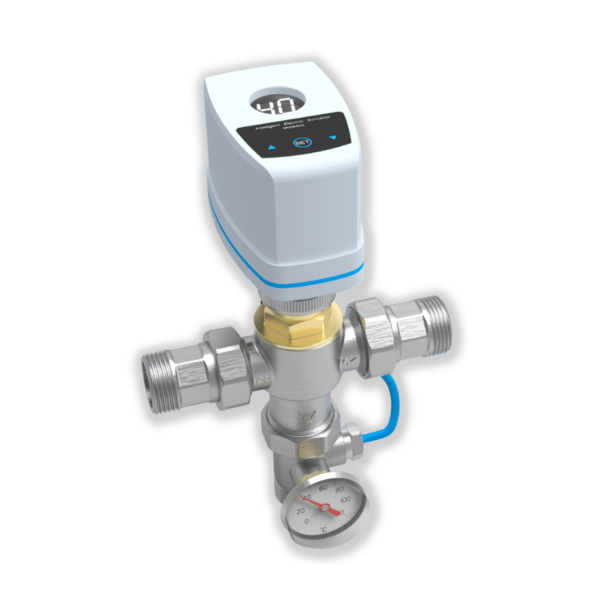
Combines a mechanical thermostatic cartridge with an integrated electric actuator, bridging the self-acting and actuated approaches. An LCD display shows the outlet temperature and an optional networking feature enables remote management through IoT applications.
| Parameter | 910064CC |
|---|---|
| Valve body material | Brass |
| Voltage | DC 24V |
| Control accuracy | ±2.0°C |
| Hot water inlet | 60°C to 65°C |
| Cold water inlet | 10°C to 15°C |
| Maximum dynamic pressure | 5 bar |
| Minimum dynamic pressure | 0.5 bar |
| Certification | CE, WRAS, RoHS |
910018CC Solar Water Heater Thermostatic Mixing Valve
Designed for the high and variable storage temperatures solar collectors produce. Integral check valves and strainers on both inlets provide automatic shutoff if either supply fails.
| Parameter | 910018CC |
|---|---|
| Available sizes | DN15, DN20, DN25, DN40 |
| Standards | EN1111, EN1999, QB2606-2006 |
| Body material | Nickel-plated brass, copper valve core |
| Adjustment range | 30°C to 65°C |
| Control accuracy | ±2.0°C |
| Highest working temperature | 95°C |
| Maximum static pressure | 10 bar |
910028NT Scald Protection Valve
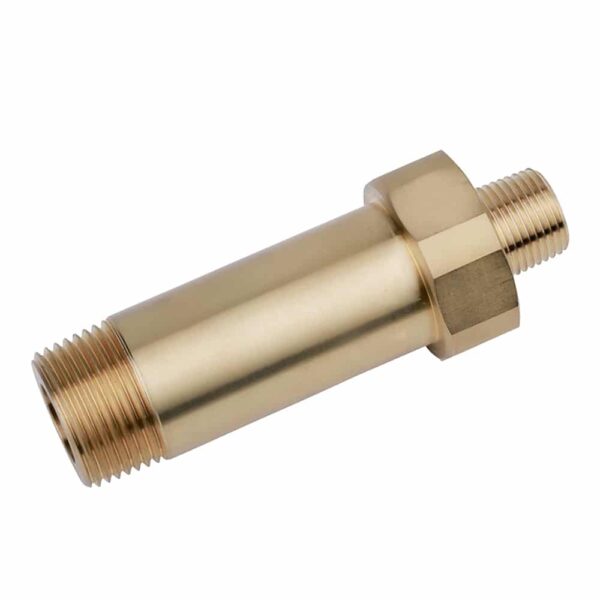
A self-acting shut-off device that blocks flow when water temperature rises to the protection point and reopens automatically once it falls back. Requires no electricity and resets itself.
| Parameter | 910028NT |
|---|---|
| Body material | Brass |
| Protection temperature | 43.3°C full protection |
| Reset temperature | 35°C |
| Working temperature range | -30°C to 80°C |
| Maximum pressure | 1 MPa (10 bar) |
| Maximum flow | 20 L/min at 300 kPa |
| Control accuracy | ±1°C |
| Thread | 3/8″ NPT, 3/4″ NPT |
930004NT Temperature and Pressure Relief Valve
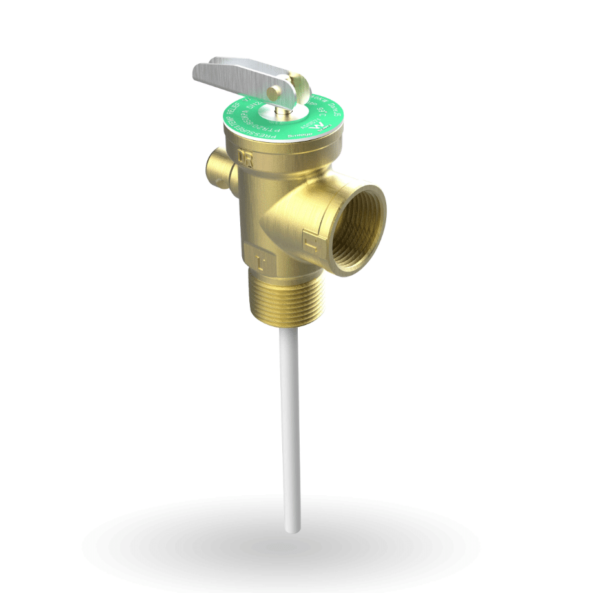
Protects the storage vessel by relieving pressure or temperature before either reaches a dangerous level. Available across seven pressure ratings so the valve can be matched to the tank it protects.
| Parameter | 930004NT |
|---|---|
| Opening temperature | 93°C to 99°C |
| Resetting temperature | ≥70°C |
| Pressure ratings | 500 to 1400 kPa across seven options |
| Water-touching material | DZR brass |
| Sizes | DN15 (1/2″), DN20 (3/4″) |
| Standard | AS1357.1 |
The range also includes freeze protection valves, dynamic flow balancing valves, thermostatic diverter valves, and circulation control valves. Because the wax elements inside them are produced in the same facility, switching characteristics can be specified at the source rather than selected from what is available on the market.
Installation and Maintenance
Correct installation determines whether a correctly specified valve actually performs.
Observe flow direction. Every temperature control valve has a defined direction, and one fitted backwards will often pass fluid while doing nothing useful. Because the symptom is silent rather than obvious, this fault can persist for years.
Ensure the element is wetted. The sensing element must be in direct contact with the flowing fluid whose temperature it is measuring. A position where air can be trapped around it, or where flow bypasses it, delays or prevents response.
Position for the intended function. A safety shut-off device fitted downstream of a mixing valve will only ever see water that has already been made safe, so it can never act. It belongs where it senses the actual source condition.
Keep it accessible. Verification, adjustment, and eventual replacement all require access. A valve sealed behind fixed panelling turns a five-minute check into an hour’s work, with the predictable result that the check stops happening.
For maintenance, verify the delivered temperature periodically rather than assuming it. Limescale accumulating around the element in hard water areas is the most common cause of gradual drift, and where water quality is poor a sediment pre-filter upstream extends the working life of every valve in the system. A valve that no longer acts at its rated temperature should be replaced rather than adjusted, since its whole value rests on that threshold being dependable.
“The mistake I see most often is buyers treating temperature control valve as if it names one product. It names a family, and the members do genuinely different things. Someone asks for a temperature control valve, we ask what they want to happen when the fluid gets too hot, and about half the time the answer reveals they need the opposite of what they asked for. If you want the supply to keep running at a safe temperature, that is a mixing valve. If you want it to stop, that is a shut-off. If you want the tank protected rather than the person, that is a relief valve. Answer that one question first and the rest of the specification follows easily. Get it wrong and no amount of quality in the valve itself will help.”
— Maggie Shen, Director of Legom
Working with Legom
Legom has handled many smart home and office projects requiring modern HVAC systems, produces quality components in-house, and works on OEM and ODM terms for large-scale cooperation. Customers can order from small-scale requirements upward, and corporate clients placing large orders are supported through long-term supply arrangements.
Because Legom manufactures the wax thermostatic elements, valve bodies, thermal actuators, manifolds, and thermostats at the same facility, a complete temperature control system can be sourced from one manufacturer with compatibility designed in rather than assumed. Full OEM and ODM services cover temperature range, switching thresholds, pressure rating, connection size, and body material, all handled under confidentiality. Contact the Legom technical team to discuss the right valve specification for your application.
Frequently Asked Questions
What is a temperature control valve?
A temperature control valve regulates the temperature of a fluid, either by blending hot and cold streams to produce a controlled outlet temperature, by throttling or shutting off flow when a threshold is crossed, or by diverting fluid down a different path according to temperature. The term covers a family of devices rather than a single product, including thermostatic mixing valves, scald protection valves, temperature and pressure relief valves, freeze protection valves, and diverting valves. Identifying which of the three actions you need is the first and most important step in selecting one.
How does a temperature control valve work without electricity?
Self-acting valves use a wax thermostatic element. Wax sealed inside a capsule expands as it warms and contracts as it cools, and because the capsule constrains it in one direction, that expansion drives a piston which moves the valve. The physical properties of the wax perform both the sensing and the actuation, so no power supply, sensor wiring, or controller is required. This matters for safety functions, because the valve continues protecting the system during a power failure and cannot be accidentally switched off or misconfigured.
What is the difference between a two-way, three-way and four-way valve?
A two-way valve has one inlet and one outlet, and simply opens, closes, or throttles a single stream. A three-way valve is the most common in temperature control: in a mixing arrangement it has two inlets, hot and cold, and one blended outlet where the element senses the mixed temperature and adjusts the proportions. In a diverting arrangement the flow reverses, with one inlet and two outlets. A four-way valve adds a port to circulate part of the flow back toward the heat source, protecting a boiler or heat pump from sudden cold return water. Mixing and diverting valves are not interchangeable.
What temperature control valve does underfloor heating need?
Underfloor heating needs a thermostatic mixing valve between the heat source and the manifold. A boiler produces water at 60 to 80°C while the floor requires 30 to 45°C, so the valve blends hot supply with cooler return to deliver the correct flow temperature. This protects the floor construction and covering while improving efficiency, particularly with a heat pump, since a heat pump producing 35°C water operates at a considerably higher coefficient of performance than one producing 45°C. Room-level control is then handled separately by thermal actuators on the manifold branches responding to room thermostats.
How accurate should a temperature control valve be?
Accuracy requirements depend on the application, but the figure to examine is not what the valve achieves when new. It is what it retains after tens of thousands of operating cycles. A quality wax element holds its calibration over 100,000 cycles, while a poorly made one drifts, which in a mixing valve means the delivered temperature moves gradually without any obvious symptom. Typical control accuracy on quality thermostatic valves ranges from ±1°C to ±2°C. For safety-critical applications, ask specifically about cycle rating and retained accuracy rather than the headline specification.
Can one valve both mix and shut off?
Not usually, and it is generally better that it cannot. A mixing valve is a control device that adjusts continuously, and control devices can drift out of calibration over years of service without an obvious symptom. A shut-off valve does one binary thing that is straightforward to verify. Many well-designed systems therefore use a mixing valve for primary temperature control and an independent shut-off device behind it as a safety layer, so that a drift in the first does not remove protection entirely. Combining both functions in one device would defeat that independence.
What certification should a temperature control valve carry?
It depends on the application and market. For products in contact with drinking water, WRAS approval is the recognised route in the UK and ACS in France, both confirming that materials will not contaminate the water. European standards such as EN 1111 and EN 1999 apply to thermostatic mixing valves for sanitary and solar applications. Relief valves may be subject to standards like AS1357.1. Confirm two things with any supplier: that the certificate covers the specific model you are ordering rather than the range generally, and that test documentation can be supplied for your own regulatory submission.
Why did my water pressure drop after fitting a temperature control valve?
Every component added to a pipe run consumes some of the available pressure, and a valve is no exception. On a system with generous pressure this is immaterial, but on one already marginal at the furthest outlet, adding a valve without checking its pressure loss against the available head can noticeably weaken a shower. This is a design oversight rather than a fault. Manufacturers publish a flow characteristic curve showing pressure drop against flow rate, and checking it against your system before ordering takes a few minutes and prevents an installation that is technically correct but experienced as a downgrade.
How often should a temperature control valve be checked?
Annual verification is the general recommendation, and regulated environments such as healthcare facilities usually have more frequent mandated schedules. Verification means confirming the valve still acts at its rated temperature, not merely that it passes fluid. Limescale accumulating around the element in hard water areas is the most common cause of gradual drift, so systems in hard water regions warrant more frequent checks. A valve whose set point has moved noticeably should be replaced rather than adjusted, since a threshold that cannot be trusted provides false reassurance rather than protection.
Reviewed by Maggie Shen, Director at Legom, on July 30, 2026. This guide to temperature control valves was reviewed for technical accuracy, including port configuration terminology and the distinction between blending, shut-off, and diverting functions.