

Water is a vital item in the household. Many daily activities involve water, as simple as if you want to take a shower or wash the dishes. In most countries, hot water, not just ordinary water, is a primary need. Do you often get bored if you run out of hot water? Of course, this will ruin your mood. You had better switch to a tankless water heater. Now, there are many technological innovations in heaters so that they are more efficient and sophisticated. What are the technological advances in this type of heater?
The Latest Technology in Tankless Water Heaters
Often, the water heater in your home experiences problems. For example, the water doesn’t flow or runs out when you need it. The heater in your home may also not be compact, so it takes up a lot of space. The latest solution you can try is installing a tankless type of water heater. The unit is very compact and more efficient than the conventional type.
If most households install water heaters using the conventional method (filling the tank and then heating it), of course, this is very wasteful of energy. A storage tank must keep its contents hot around the clock, losing heat through the tank walls even when nobody is using any water. This is known as standby heat loss, and it is energy you pay for without ever seeing it come out of a tap.
For example, a family member is taking a hot shower while another is soaking in hot water. It will take a lot of time to wait for the tank to empty until it heats up again. That is the need for continuous adjustment and innovation in water heaters. The following are technological innovations in tankless water heaters.
A More Efficient Work System
Today’s tankless heaters can work considerably more efficiently than first-generation tankless heaters, with some models achieving improvements of around 17 percent. It is because there is efficiency in the exhaust system which can capture more heat energy before it leaves the ventilation system. Condensing models take this further by recovering heat from the flue gases that older units simply vented outside. Even though the price is higher, perhaps around 25 percent more, this effort will continue to develop. It means that this device will become more efficient over time.
Control It with Wi-Fi
One of the ways to use the latest technology in tankless water heaters is by using a Wi-Fi connection to adjust the temperature and other settings just via your smartphone. When your device experiences problems, this unit can identify it. This way, you will respond more quickly to issues that arise so that repair costs will be cheaper.
If you have forgotten the timing for descaling, the feature on this unit will tell you the time. It is very effective and makes things easier for you, especially if you are a high-mobility person. Some connected models also record how much hot water you use, which helps you see exactly where the energy goes across a month.
Produces Hot Water Very Quickly
Believe it or not, tankless heaters only need around 15 seconds to process ordinary water into hot water. Then, wait a moment until the water flows from the tap and is ready for you to use.
You can also adjust the distance between heaters and other equipment to save and reduce waiting time. Furthermore, you can also use a smartphone or motion sensor to turn on the pump. Water will flow into the pipes and through the heating system. When you open the tap, within seconds hot water will flow.
How a Tankless Water Heater Actually Works
Understanding the mechanism helps explain both the advantages and the quirks of this type of heater. A tankless unit does not store any water at all. When you open a hot tap, a flow sensor inside the unit detects the movement of water and switches on the burner or the electric heating element. Cold water then travels through a heat exchanger, absorbing heat as it passes, and emerges hot at the other end. When you close the tap, the flow stops and the heater shuts down immediately.
This is why the system is called on-demand heating. There is no reservoir waiting to be reheated, so there is no standby loss, and in principle the supply of hot water never runs out. The trade-off is that the unit can only heat as much water as it can process at one time, which is measured as flow rate. If several outlets run at once and the demand exceeds that flow rate, the water arriving at each tap will be cooler than expected.
Tankless Compared with a Conventional Tank Heater
Both types have their place, and the right choice depends on your household. The table below sets out the main differences.
| Aspect | Tankless Water Heater | Conventional Tank Heater |
|---|---|---|
| Hot water supply | Continuous, limited by flow rate | Limited by tank volume |
| Standby heat loss | None | Present, tank stays hot all day |
| Space required | Compact, wall-mounted | Bulky floor-standing tank |
| Typical lifespan | Up to 20 years (gas), 7 to 10 years (electric) | Around 10 to 15 years |
| Upfront cost | Higher, plus installation work | Lower |
| Temperature stability | Can fluctuate with flow changes | More stable from stored volume |
Do You Plan to Install a Tankless Water Heater? Check the Guides!
The advantages of this type of water heater are likely to motivate more people to install similar items in their homes. However, instead of just following the trend, you should pay attention to important points so you don’t lose money afterward.
- When considering the costs of tankless water heaters, the type and installation requirements play a significant role in determining the price. Electric tankless water heaters typically have an average purchase price ranging from $600 to $1,000. In contrast, propane models generally cost between $1,000 and $2,000, while natural gas units are slightly more expensive, with prices ranging from $1,500 to $2,600. These figures can vary based on factors such as unit size, brand, and specific installation needs, and prices also shift over time, so treat them as a guide and request a current quote for your own project.
- Then installation without a tank cannot be done carelessly. It is very good for you to use the services and energy of professionals in this field. Why? It is quite a complex job that requires precise calculations. Professional workers help you arrange water connections, ventilation systems, and gas that are safe from leaks and organize cable circuits and circuit breakers. It depends on what type of tankless heater you choose. The point is, this job is serious. This point means you need sufficient funds to hire these experts.
- You should pay attention to the warranty and the average lifespan of this type of water heater. Gas tankless water heaters should be able to function for up to 20 years or more, an average lifetime notably longer than tank-powered heaters. However, electric tankless heaters generally operate well for seven to ten years.
- You can buy a new unit at a shop that provides heaters and accessories like pipes, cables, etc. You might also get it from the marketplace, but you have to be wise in choosing it by paying attention to ratings, brands, and many other factors.
- What you can’t miss is the maintenance side of the unit. Surely, we want durable products to save money and not have to worry about it. You can use an annual maintenance service to clean or replace the water, air filters, and check other components. Descaling matters especially in hard water areas, since limescale builds up inside the heat exchanger and reduces efficiency over time.
Keeping Tankless Hot Water Safe and Stable
There is one characteristic of tankless heaters that manufacturers rarely discuss openly. Because the unit heats water as it flows, the outlet temperature can fluctuate when the flow rate changes, for example when someone opens another tap while you are in the shower. Older units also produce what is often called a cold water sandwich, a brief slug of cooler water that arrives between two bursts of hot water when the heater cycles on and off.
This is exactly where a thermostatic mixing valve earns its place. Installed downstream of the heater, it blends hot and cold water continuously to hold the delivered temperature steady, absorbing the fluctuations before they reach the tap. It also protects against scalding, which matters because a tankless unit can deliver very hot water indefinitely rather than being limited to a tank of it.
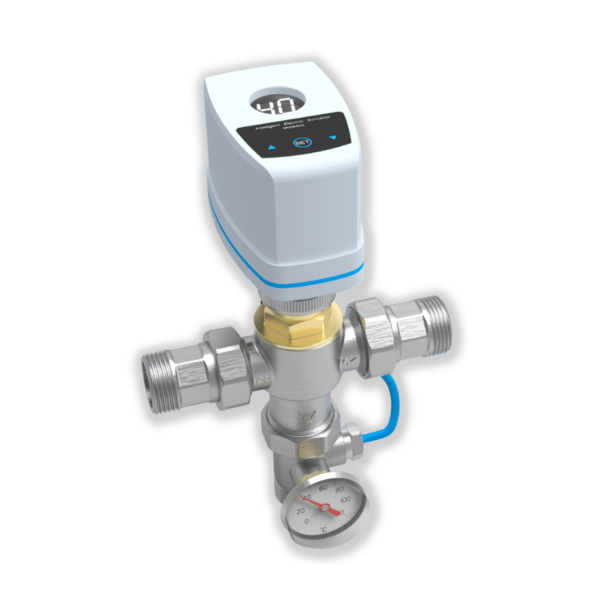
The Legom 910064CC Electronic Thermostatic Mixing Valve is well suited to this role. It combines a mechanical thermostatic cartridge with an integrated electric actuator, holds the outlet temperature to within ±2.0°C, and displays the current temperature on an LCD screen. An optional networking feature allows remote temperature management through IoT applications, which pairs naturally with a Wi-Fi controlled tankless heater. The table below summarizes the key parameters.
| Specification | 910064CC |
|---|---|
| Valve body material | Brass |
| Voltage | DC 24V |
| Temperature accuracy | ±2.0°C |
| Hot water inlet temperature | 60°C to 65°C |
| Cold water inlet temperature | 10°C to 15°C |
| Maximum dynamic pressure | 5 bar |
| Certification | CE, WRAS, RoHS |
For households where scald risk is the main concern, particularly with children or elderly occupants, a dedicated scald protection valve provides an additional layer. The Legom 910028NT closes automatically when the water temperature rises to its protection threshold of 43.3°C and reopens once the temperature falls back below it. If your system uses solar thermal preheating alongside a tankless unit, the 910018CC, certified to EN1111 and EN1999 with a 95°C maximum working temperature, is designed for those higher inlet conditions.
“Tankless water heaters solve the running-out problem beautifully, but they introduce a different one that people only notice after installation: the temperature moves when the flow moves. Someone starts the dishwasher and the shower goes cooler for a moment. A good mixing valve downstream absorbs that variation completely, which is why we see so many tankless installations paired with one. It is a small component next to the cost of the heater itself, yet it is the part that determines whether the water arriving at the tap feels consistent every single time.”
— Maggie Shen, Director of Legom
Technological developments, including water heating systems, have a positive impact, although on the other hand, there are always disadvantages. Finally, in choosing a tankless water heater or changing from a unit with a tank to a unit without one, several points are significant for every consumer to consider. You can consult an expert before making this decision so that it meets your expectations.
Frequently Asked Questions
Does a tankless water heater really never run out of hot water?
In principle yes, because it heats water on demand rather than drawing from a stored tank. In practice the limit is flow rate rather than volume. A tankless unit can only heat a certain number of litres per minute to the target temperature, so if several outlets run simultaneously and exceed that capacity, the water reaching each one will be cooler. Sizing the unit correctly for your household’s peak demand is therefore essential. For a large family that regularly runs a shower and appliances at once, a higher-capacity unit or two units in parallel may be needed.
Why does the water temperature fluctuate on a tankless heater?
Because the heater adjusts its output to the water passing through it, any change in flow rate affects the outlet temperature. Opening another tap reduces the flow at your outlet and can cause a brief temperature swing. Older units also produce a cold water sandwich, a short burst of cooler water when the heater cycles between on and off states. Modern units manage this better with modulating burners, and installing a thermostatic mixing valve downstream removes the remaining variation by continuously blending hot and cold water to hold a steady delivered temperature.
Do tankless water heaters need a mixing valve?
They are not always required by regulation, but they are strongly recommended for both comfort and safety. A thermostatic mixing valve stabilizes the delivered temperature against the flow-related fluctuations tankless units produce, and it prevents scalding by capping the outlet temperature regardless of what the heater is producing. This is particularly important in households with young children or elderly occupants, who are most vulnerable to burns. A valve holding accuracy within ±2.0°C keeps the water at the tap consistent and safe.
How often should a tankless water heater be descaled?
Most manufacturers recommend descaling once a year, though homes in hard water areas may need it more frequently. Limescale accumulates inside the heat exchanger, restricting flow and forcing the unit to work harder to reach the target temperature, which reduces efficiency and shortens the equipment’s life. Many modern units track usage and issue a descaling reminder through their app, removing the need to remember the schedule yourself. Combining descaling with an annual service that also checks filters and connections keeps the unit performing as intended.
Is a tankless water heater worth the higher upfront cost?
It depends on your household’s hot water use and how long you plan to stay in the property. The higher purchase and installation cost is offset over time by the elimination of standby heat loss and, for gas models, a considerably longer service life of up to 20 years compared with around 10 to 15 years for a tank. Households that use hot water throughout the day tend to recoup the difference faster than those with low usage. Because installation costs vary widely depending on gas, ventilation, and electrical requirements, obtaining a detailed quote for your specific property is the only reliable way to assess the payback.
Reviewed by Maggie Shen, Director at Legom, on July 22, 2026. This article on tankless water heater technology was reviewed for technical accuracy, including the temperature control and scald protection guidance and the 910064CC valve specifications.